Understanding the Self Through the Four States of Consciousness
The Mandukya Upanishad, though the shortest among the principal Upanishads, presents the most profound inquiry into the nature of the Self and consciousness. Verses 8 to 11 introduce the framework of the four states of consciousness—waking, dreaming, deep sleep, and the transcendent fourth, Turiya. These states are symbolized by the sacred syllable Om, which encapsulates the totality of experience. Gaudapada’s Karikas 13 to 18 provide a philosophical exposition on these states, explaining their impermanence and revealing the changeless reality underlying them. He emphasizes that the true Self is beyond the three common states and is to be realized as pure, non-dual awareness. This section lays the foundation for Advaita Vedanta by identifying the Self with Brahman, the ultimate reality. For More Information Click Here

Mandukya Upanishad Mantras 8–11 and Gaudapada’s Karikas 13–18
Mantras 8 to 11
Mantra 8:
अथातो माण्डूक्यं प्राहुः –
Now, therefore, the explanation of the Mandukya (Upanishad) is as follows: The word Om is the whole syllable (purna-akshara) of the universe and symbolizes the four states of consciousness.
Mantra 9:
अथातो माण्डूक्यं प्राहुः –
The four states are:
-
Waking (Jagrat) – outwardly cognitive state, where consciousness is turned outward through the senses.
-
Dreaming (Svapna) – inwardly cognitive state, where the mind experiences dreams, with internal objects.
-
Deep Sleep (Sushupti) – undifferentiated state, where there is no desire or dream, but a blissful state of rest.
-
Turiya (The Fourth) – transcendental state, beyond waking, dreaming, and deep sleep, pure consciousness, non-dual and infinite.
Mantra 10:
उत जग्रतोऽस्य विशिष्टाः प्रत्ययाः –
The waking state is characterized by outward experiences through the senses, aware of the external world.
Mantra 11:
सर्वं प्रपश्यति –
In this state, the self identifies with the physical body and perceives the world outside. This is the gross body and the outward cognitive function of the self. For More Information Click Here

Gaudapada Karika (Karika) Nos. 13 to 18 — Commentary on Mandukya Upanishad
Karika 13:
The three states — waking, dreaming, and deep sleep — arise due to ignorance (avidya). They are transient and limited, not the true Self. The Self remains constant behind these changes.
Karika 14:
The waking state is outwardly cognitive; the self identifies with the physical body and experiences the external world. This identification is due to ignorance.
Karika 15:
The dream state is inwardly cognitive; the self experiences mental images and impressions (sanskaras) without external objects. This is a subtle form of consciousness.
Karika 16:
The deep sleep state is a state where the mind is inactive, and no desires or distinctions arise. It is a blissful state but limited, as the self is not manifestly conscious.
Karika 17:
The three states are like waves arising on the ocean of pure consciousness (Brahman). They are not different from the Self, but the Self is unchanging and witness to these states.
Karika 18:
The fourth (Turiya) is beyond these three states. It is the pure consciousness, without any modifications, the ultimate reality, the true Self (Atman), and it is identical with Brahman.
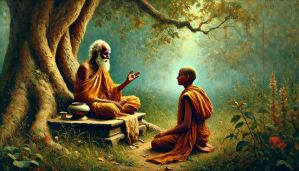
Adi Shankaracharya’s Insights on Mandukya Upanishad Mantras 8–11 & Karikas 13–18
-
On the Four States (Mantras 8–11)
Shankaracharya explains that the Self (Atman) appears to undergo changes as it passes through waking (jāgrat), dreaming (svapna), and deep sleep (suṣupti). However, these changes are only apparent, caused by ignorance (avidyā). The true nature of the Self is Turiya — unchanging, eternal, and beyond duality. He highlights that the identification with the body, mind, or intellect in the three states is a superimposition (adhyāsa) upon the Self. For More Information Click Here -
Om as Symbol (Mantra 8)
He emphasizes that the syllable “Om” is not merely a sound, but a profound symbol of the Self and Brahman. Each of its components — A, U, M — correspond to the three states, and silence beyond “M” points to Turiya. Meditating on Om with understanding leads to realization of the Self. -
On Gaudapada’s Karikas (13–18)
Shankara agrees with Gaudapada that the three states are mithyā (illusory or conditionally real) and born of ignorance. He reinforces the Karika’s central theme — that the Turiya is the substratum of all experience, unassociated with waking, dreaming, or sleeping. It is the only reality, and liberation comes from knowing this truth directly through viveka (discrimination) and nididhyāsana (contemplative absorption). -
Self as Witness and Non-doer
Shankara points out that the Self is the witness (sākṣī) of all states but remains untouched. It does not act or enjoy; it is always free (mukta). The three states are modifications of the mind, not of the Self. -
Practical Teaching
For seekers, Shankaracharya advises constant discernment between the eternal and the ephemeral, and abiding in the awareness of Turiya. He views the Mandukya Upanishad as sufficient by itself for liberation when properly understood.
Conclusion
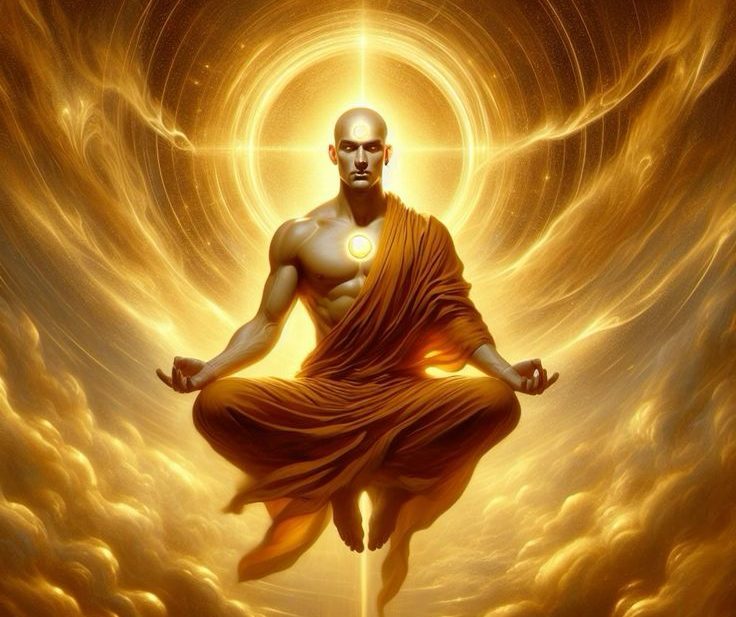
In conclusion, the Mandukya Upanishad along with Gaudapada’s Karikas and Adi Shankaracharya’s insights provides a profound roadmap to self-realization. By analyzing the three states—waking, dreaming, and deep sleep—it leads the seeker to recognize the ever-present, unchanging Turiya, the true Self. Shankaracharya emphasizes that this Self is non-dual, unattached, and beyond all mental modifications. The sacred syllable Om becomes both the symbol and the means to realize this truth. True liberation lies in understanding that we are not the body, mind, or ego, but the pure, limitless consciousness. This knowledge, when deeply assimilated, dissolves ignorance and reveals Brahman as our very own Self.
Join Our Classes:
The Upanishads are more than just ancient texts—they are timeless guides to living with clarity, balance, and inner peace. Our classes make their profound wisdom easy to understand and apply in everyday life. Join us to explore these teachings and discover a new way of seeing yourself and the world!