Chapter 1 – Section 1: The Story of Nachiketa and the Three Boons
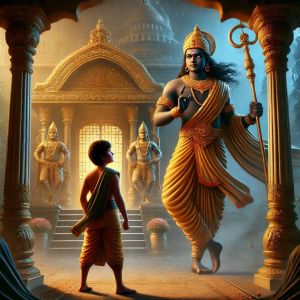
In Chapter 1, Section 1 of the Katho Upanishad, the story of Nachiketa unfolds through his father’s sacrificial ritual, where he notices the insincerity of the offerings. Questioning his father’s actions, he is eventually sent to Yama, the lord of death. Nachiketa patiently waits for three nights at Yama’s abode without receiving proper hospitality, prompting Yama to grant him three boons in recompense. For the first boon, Nachiketa seeks reconciliation with his father, and for the second, he requests knowledge of the sacred fire sacrifice—both are readily granted. For the third boon, however, he asks the profound question of what happens after death. Yama, hesitant, tests him with riches, pleasures, and distractions, but Nachiketa remains resolute, setting the stage for the deep dialogue on immortality and Self-knowledge. For More Information Click Here
Theme and Importance of Chapter 1 – Section 1
The central theme of this section is the spiritual determination of Nachiketa and his quest for truth beyond worldly gains. It highlights the contrast between superficial religious acts driven by selfish motives and the sincere pursuit of higher knowledge. The importance lies in Nachiketa’s refusal to be swayed by wealth, power, or pleasure, showing the ideal attitude of a true seeker who values sreyas (the path of the good) over preyas (the path of the pleasant). By placing the question of life after death at the forefront, this section sets the foundation for the Upanishad’s exploration of the immortal Self (Atman) as the ultimate reality.
Chapter 1 – Section 1: Verse-by-Verse Summary (29 Verses)
- Vajashrava performs a sacrificial ritual, giving away old, weak cows as gifts.
- His son Nachiketa, noticing the insincerity, reflects on the futility of such charity.
- He wonders to whom he will be given as a part of the sacrifice.
- Nachiketa repeatedly asks his father about his own fate.
- Irritated, his father angrily says, “I give you to Yama (the god of death).”
- Nachiketa accepts his father’s words as truth and prepares to meet Yama.
- He reflects on the transient nature of life and possessions.
- Reassuring himself, he sees no fear in going to Yama’s abode.
- Nachiketa reaches Yama’s house but finds him absent.
- He waits there for three nights without food or hospitality.
- Yama returns and is troubled that a Brahmachari guest was left unattended.
- Yama instructs his household to atone for the neglect of a sacred guest.
- He acknowledges that such a guest is like Agni (fire), bringing blessing or curse.
- To make amends, Yama promises Nachiketa three boons.
- Nachiketa asks as his first boon that his father’s anger be pacified and love restored.
- Yama grants this boon, assuring his father’s heart will welcome him with joy.
- For the second boon, Nachiketa asks for knowledge of the sacred fire sacrifice leading to heaven.
- Yama explains the ritual in detail, describing its structure.
- Nachiketa listens carefully and repeats the teaching back with precision.
- Yama is pleased and grants him a special name for this fire: “Nachiketa Agni.”
- He further blesses him, saying those who perform this sacrifice gain immortality in heaven.
- Yama then asks Nachiketa to choose his third boon.
- Nachiketa requests knowledge of what happens after death—whether the Self still exists or not.
- Yama hesitates, calling this question subtle and difficult, even for gods.
- He urges Nachiketa to ask for sons, wealth, long life, or power instead.
- Yama tempts him with pleasures, celestial maidens, and vast riches.
- Nachiketa firmly rejects these, declaring they are fleeting and cannot satisfy.
- He emphasizes that worldly joys decay and cannot make one immortal.
- Nachiketa insists only the knowledge of the eternal Self will fulfill his quest.
This section beautifully shows Nachiketa’s clarity, courage, and focus on Self-knowledge instead of temporary gains. For More Information Click Here
Shankaracharya’s Insights on Chapter 1 – Section 1
Shankaracharya explains that Vajashrava’s offering of useless cows shows ritual without sincerity has no value. Nachiketa’s sharp questioning reflects purity of mind and a seeker’s honesty. Being “given to Yama” symbolizes turning toward the teacher of immortality. The three nights of waiting signify tapas, leading to the three boons: harmony with family, understanding of ritual, and the quest for liberation. Nachiketa’s refusal of wealth and pleasure highlights choosing sreyas (the good) over preyas (the pleasant). His third boon—knowledge of what lies beyond death—is the essence of Vedanta. For Sankara, this inquiry into the Self is the only path to moksa. This section, thus, marks the seeker’s readiness for ultimate truth. For More Information Click Here

Conclusion
Chapter 1 – Section 1 of the Katho Upanishad sets the stage for the entire dialogue between Nachiketa and Yama. Through the story, it emphasizes the contrast between hollow ritual and true spiritual seeking, highlighting how only sincerity and the pursuit of Self-knowledge lead to lasting fulfillment. Nachiketa’s steadfast choice of sreyas over preyas becomes a model for all seekers of truth. By presenting the three boons, the Upanishad bridges worldly duties, ritual knowledge, and finally the quest for the immortal Self—signaling that liberation is the highest human goal.
Join Our Classes:
The Upanishads are more than just ancient texts—they are timeless guides to living with clarity, balance, and inner peace. Our classes make their profound wisdom easy to understand and apply in everyday life. Join us to explore these teachings and discover a new way of seeing yourself and the world!