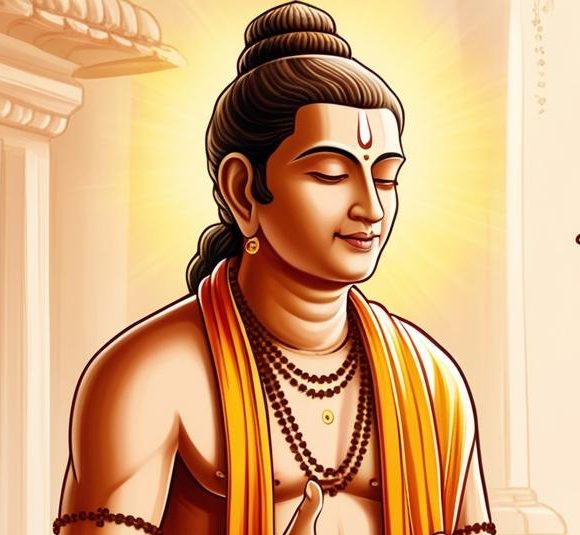
Chapter 2 – Sankhya Yoga
Chapter 2 of the Bhagavad Gita contains 72 verses and serves as the philosophical heart of the Gita. After Arjuna’s emotional collapse in Chapter 1, Krishna begins His spiritual discourse here by teaching the essential nature of reality, duty, knowledge, and action. This chapter bridges Arjuna’s confusion and the practical spiritual paths Krishna will unfold throughout the rest of the Gita. It is called Sankhya Yoga — the yoga of analytical knowledge — because it reveals how discriminative wisdom leads to inner freedom and union with the Self. Click Here To Access more other text.

Meaning of Sankhya Yoga
The word Sankhya originally refers to knowledge, discrimination, and analytical understanding — especially the ability to distinguish the permanent from the transient. In the Gita, this means recognizing:
-
The eternal Self (Ātman) distinct from the body and mind
-
The impermanent nature of the world and sensory experience
-
The proper way to act without attachment
Merged with Yoga, it becomes a method to unite the individual self with the supreme Self by understanding true nature and living accordingly.
Krishna teaches that true yoga arises when one sees reality clearly and acts in harmony with that insight — without resentment, fear, or attachment. Click view PDF.
Significance of Chapter 2 in the Gita
Chapter 2 is pivotal because:
-
It transforms Arjuna’s emotional confusion into spiritual inquiry
-
It introduces the eternal nature of the soul
-
It explains how to act without attachment (Karma Yoga)
-
It lays the foundation for self-knowledge and equanimity (Jnana Yoga)
-
It describes the ideal state of the mind — sthita-prajña (steady wisdom)
-
It prepares the seeker for deeper teachings in later chapters
This chapter contains many of the most quoted and philosophically rich verses of the entire Gita. Click view PDF.

Key Concepts & Teachings
1. From Confusion to Inquiry (Verses 1–12)
At the start of Chapter 2, Arjuna is still overwhelmed by sorrow and unable to act from clarity. Krishna gently rebukes his weakness of heart and urges him to rise from emotional collapse and seek understanding. This marks the shift from confusion to inquiry.
2. Eternal Nature of the Soul (Verses 13–30)
Krishna teaches that the Self (Ātman) never dies, is eternal, unchanging, and distinct from the physical body. The body goes through birth, growth, decay, and death, but the soul simply passes from one state to another. Wise people do not grieve for the body because the Self is beyond physical destruction.
This truth: Click view PDF.
-
Removes fear of death
-
Reduces grief based on temporary identity
-
Grounds action in truth rather than emotion
This teaching helps Arjuna see beyond the immediate emotional crisis toward his true, unchanging nature.
3. Duty and Right Action (Verses 31–38)
Krishna reminds Arjuna of his duty (svadharma) as a warrior. He explains that abandoning duty for fear or attachment is not appropriate for one whose responsibility is to uphold righteousness. Krishna urges him to act with courage, as action aligned with dharma does not bind when performed without craving the results.
4. Karma Yoga — Selfless Action (Verses 39–53)
Krishna introduces Karma Yoga — performing actions without attachment to results. A person should:
-
Focus on the action itself
-
Not cling to success or failure
-
Offer the results to the Divine
-
Act as an instrument rather than the doer
This attitude purifies the mind and leads to inner peace. Krishna teaches that action done with attachment binds the soul, but action done without attachment liberates it. Click view PDF.
5. Wisdom Through Equanimity (Verses 54–72)
Krishna then discusses Jnana Yoga — the path of knowledge and inner wisdom. The truly wise person is:
-
Steady in pleasure and pain
-
Unmoved by success and failure
-
Detached from the senses
-
Self-controlled and peaceful
-
Established in the Self
Such a person sees all beings equally, remains free from desire and anger, and abides in inner calm. Krishna presents the ideal of sthita-prajña (one of stable wisdom), whose mind is grounded in self-realization and not distracted by the world. Click view PDF.

Psychological and Spiritual Dimensions
Chapter 2 also speaks to the inner struggle of every human being:
-
It shows how fear and attachment cloud judgment
-
It teaches how self-understanding stabilizes the mind
-
It demonstrates how to act without ego-driven motives
-
It presents equanimity as the key to emotional balance
The chapter moves from ego-based identity (I and mine) to Self-based identity (I am the soul), a shift that transforms life perspective.
Practical Applications
Living with Detachment
Perform daily duties with dedication, but without craving outcomes. This reduces anxiety, fear, and disappointment.
Equanimity in Life
Whatever life brings — success or failure, pleasure or pain — maintain a balanced mind. This leads to inner peace. Click view PDF.

Understanding Identity
Recognizing that we are not merely the body helps reduce fear of loss and death, increasing clarity and confidence in action.
Conclusion
Chapter 2 – Sankhya Yoga is the heart of the Bhagavad Gita. Krishna’s teachings here help Arjuna (and all seekers) rise above emotional turmoil, recognize the eternal Self, act without attachment, and cultivate a stable, wise mind. Through this teaching, a person begins to see beyond temporary appearances and acts from clarity, purpose, and inner peace. This chapter not only lays the foundation for the rest of the Gita but also provides practical guidance for spiritual growth in everyday life.