Introduction to the Aitareya Upanishad: The Self as the Source of All Creation
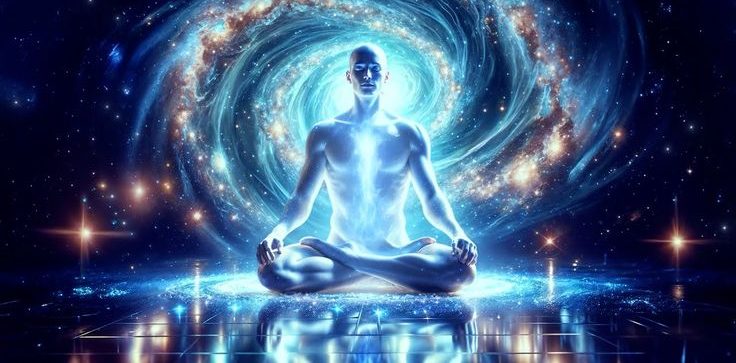
The Aitareya Upanishad, from the Rigveda, is a profound scripture that investigates the origin of the universe, the nature of the Self (Ātman), and the purpose of human birth. It begins with the declaration that in the beginning, only the Self existed. This Self manifests the cosmos, enters the body, and is realized as the very essence of all beings. The Upanishad comprises three chapters, and the first explores the process of creation—showing how all existence arises not from matter, but from pure consciousness. Adi Shankaracharya’s commentary affirms this non-dual truth: the Self is Brahman, the one without a second. For More Information Click Here
Chapter 1 – Section 1: Verses 1 to 4
Verse 1
Sanskrit:
Ātmā vā idam eka evāgra āsīt, nānyat kiñcana miṣat
Meaning:
In the beginning, verily, only the Self (Ātman) was there—nothing else that blinks (i.e., no other conscious or inert being) existed.
Shankara’s Insight:
The phrase emphasizes absolute non-duality. “Ātman alone existed” indicates that consciousness is the original and only reality, not subject to time, space, or causation. This is not a void or absence, but a fullness of pure being.
Verse 2
Sanskrit:
Sa īkṣata – lokān nu sṛjā iti
Meaning:
The Self thought: “Let me create the worlds.”
Shankara’s Insight:
This “thought” is symbolic, not literal. The Self is actionless and desireless. Creation is a spontaneous manifestation within consciousness, not caused by ignorance or want. This shows the unfolding of cosmic order within the One.
Verse 3
Sanskrit:
So ‘mbhaḥ, marīciḥ, maraḥ, āpa iti lokān asṛjata
Meaning:
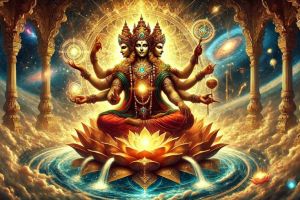
He created the worlds—Ambhas (the higher world), Marīci (sky or mid-region), Mara (mortal world or earth), and Āpa (the world of waters below).
Shankara’s Insight:
These are symbolic divisions of the cosmos. Shankara explains that the diversity of creation is apparent, not real. These realms are superimposed upon consciousness and serve as the field for the Self’s experiential play.
Verse 4
Sanskrit:
Tāsu nān devaḥ
Meaning:
In those worlds, He did not yet place the deities.
Shankara’s Insight:
Creation is incomplete without conscious functions or forces (devas), which will follow in the next stages. Shankara sees this as the progressive manifestation of consciousness—from space, to form, to sense, to life. For More Information Click Here

Shankara’s Insights: Creation as Apparent, the Self as Eternal Reality
Shankara refines the Upanishadic narrative by stating that the Self never undergoes actual change. The terms “created,” “thought,” or “entered” are used provisionally to describe what appears to happen from the empirical standpoint. In reality, there is only the unmoving, infinite Self, and all forms and functions are superimposed by ignorance (avidyā). Realization involves withdrawing these superimpositions and knowing oneself as that very Ātman.

Importance of Aitareya Upanishad – Chapter 1, Section 1, Verses 1 to 4
These four foundational verses are among the most significant in Vedantic philosophy, and their importance lies in the profound metaphysical truths they convey:
- Affirmation of Non-Duality
Verse 1 establishes that in the beginning, only the Self (Ātman) existed, denying any second entity. This is the essence of Advaita: there is no duality—only one, undivided reality. - Consciousness as the Cause of Creation
The Self “desiring” to create (Verse 2) symbolizes that creation originates from pure consciousness, not from inert matter or chance. It presents a spiritual, not material, cosmology. - Symbolic Mapping of the Universe
Verse 3 outlines a fourfold structure of the universe, representing levels of experience—higher realms, intermediate space, earthly life, and the underworld. This shows how cosmic order is embedded in consciousness. - Incomplete without Divine Forces (Verse 4)
The absence of deities at this point signifies that mere matter or worlds are not sufficient—conscious energies (devatās) must animate them. It hints at the gradual unfolding of the Self into dynamic experience. - Philosophical and Spiritual Relevance
These verses provide a framework for understanding the Self as both the source and substance of everything. They are not just cosmological but deeply experiential, guiding seekers toward self-realization. - Foundation for the Mahāvākya “Prajñānam Brahma”
The idea of consciousness being the essence of all is first hinted at here, laying the groundwork for the Upanishad’s central message: “Prajñānam Brahma” (Consciousness is Brahman).
These four verses are not merely descriptive—they invite inner contemplation and lead one from the illusion of multiplicity to the realization of oneness. For More Information Click Here
Conclusion
The opening verses of the Aitareya Upanishad offer a vision of profound simplicity: that only the Self existed before all creation. The cosmos, with all its complexity, is shown to be a projection within pure consciousness. Shankara helps us understand that the acts of creation and division are not literal transformations but apparent modifications—an illusion superimposed on the changeless Self. These teachings serve as the foundation for Advaita Vedanta, which guides the seeker to realize that their true identity is not the body or the mind, but the eternal, all-pervading Ātman—pure consciousness itself.
Join Our Classes:
The Upanishads are more than just ancient texts—they are timeless guides to living with clarity, balance, and inner peace. Our classes make their profound wisdom easy to understand and apply in everyday life. Join us to explore these teachings and discover a new way of seeing yourself and the world!