Brahmanamwise Summary – Chapter 3 & 4
Chapter 3 – Madhukanda
1.Madhu Brahmana
Theme: Unity of the cosmos and all beings through mutual dependence (madhu = honey).
-
All beings are interconnected through the sun—each one serves the other.
-
The sun is the honey of all beings, and vice versa.
-
The sky and heavenly worlds are bound to the sun in mutual benefit.
-
The directions and the Vedas reflect each other through the sun.
-
Agni (fire) and beings have a reciprocal relationship.
-
Water and beings are mutually nourishing.
-
Earth and beings exist to support each other.
-
Speech and beings mirror each other’s function.
-
Wind and beings circulate each other’s essence.
-
Breath and beings sustain each other.
-
The moon and beings nurture each other.
-
Lightning and beings express a symbiotic bond.
-
Cloud and beings feed and are fed by each other.
-
Space and beings are inherently interrelated.
-
Law (Dharma) and beings live by mutual maintenance.
-
Truth and beings are grounded in each other.
2.Panchagnividya Brahmana
Theme: The five fires (panchagni) symbolic of the life and rebirth cycle.
-
The year is a fire; its fuel is the sun; time is sacrifice.
-
The fire of heaven produces rain, which becomes food.
-
The rain (fire) leads to earthly fertility, forming the basis of life.
-
Man is a fire; the mouth is its fuel; food is its offering.
-
Woman is a fire; the womb is the altar; seed is the oblation.
-
The birth of life continues through this fivefold sacrificial cycle.
-
The soul’s journey through these fires results in rebirth.
-
Those ignorant of the Self keep rotating in this cycle.
-
Those who know transcend this chain.
-
Repetition of sacrificial imagery reinforces this symbolism.
-
Vedic deities are stationed in various fires.
-
Creation is linked to these five elements of offering.
-
The wise perceive this entire cycle as a grand sacrifice.
3.Yajnavalkya & Artabhaga Dialogue
Theme: Nature of the Self after death.
-
Yajnavalkya asserts the Self dissolves into elements post-death.
-
No duality remains; the Self merges into the cosmic order.
4.Yajnavalkya & Ushasta Dialogue
Theme: The Self as the unseen Seer.
-
The Self is not seen but sees all—beyond instruments.
-
The Self is the core of awareness; nothing perceives It.

5.Yajnavalkya & Kahola Dialogue
Theme: The Self as eternal, untouched consciousness.
-
Yajnavalkya describes the Self as pure consciousness beyond decay.
6.First Dialogue with Gargi
Theme: Foundations of the universe.
- Gargi questions about the substratum of existence.
- Yajnavalkya responds with the layers of reality—ether, etc.
- She asks about the ultimate support—what underlies all.
- He declares the imperishable Brahman as the base of all.
7.Yajnavalkya & Uddalaka Dialogue
Theme: Liberation and the path beyond death.
-
Uddalaka asks about karmic release.
-
Yajnavalkya explains the one who knows the Self transcends rebirth.
-
The knower is liberated from both action and non-action.
8.Second Dialogue with Gargi
Theme: Ultimate nature of Brahman.
- Gargi inquires further into the nature of reality.
- Yajnavalkya emphasizes that the imperishable governs all.
- Brahman is beyond time, causation, and change.
- Concludes that the knower of Brahman transcends all bondage.
9.Yajnavalkya & Vidagdha Sakalya Dialogue
Theme: Enumeration of gods, vital functions, etc.
- Sakalya questions on the number of gods, Yajnavalkya breaks it down to 1—Brahman.
- Discussions on different cosmic functions and sense organs.
- Inquiries into elements, heavens, speech, breath.
- Sakalya fails to grasp the unity behind plurality.
10.Yajnavalkya & Shakalya Continued
Theme: Continuation and culmination of earlier discussion.
-
Yajnavalkya reasserts unity of all phenomena in the Self.
11. Yajnavalkya & Jaratkarava
Theme: Ultimate fate of the Self.
-
All dissolves into the eternal—liberation is union with Brahman.
Chapter 4 – Muni Kanda / Yajnavalkya Kanda
1.Janaka Tests the Sages
Theme: Janaka challenges sages to find the knower of Brahman; Yajnavalkya stands out.
-
Janaka arranges a Brahman-contest to reward the knower of Brahman.
-
Yajnavalkya arrives and asks his pupil to take the cows.
-
Other sages challenge Yajnavalkya’s boldness.
-
Ashvala, Janaka’s priest, questions Yajnavalkya on sacrifices.
-
Yajnavalkya speaks of the vital force behind the sacrifice.
-
Discussion shifts to various cosmic forces behind rites.
-
Sun, moon, water, fire – all become instruments of offering.
-
Knowledge behind the action is the highest oblation.
-
The Self is identified as the substratum of all sacrifices.
-
The ultimate fruit is not ritual but knowledge of the Self.
-
The sacrifice without Self-knowledge is incomplete.
-
Ashvala is humbled by Yajnavalkya’s superior insight.
-
Janaka praises the discussion.
-
Yajnavalkya is challenged again—now on internal sacrifice.
-
The internal yajña is declared superior to external rituals.
2.Janaka Rewards Yajnavalkya
Theme: Karma, rebirth, and the fate of the soul.
-
Janaka gives Yajnavalkya more cows; other sages protest.
-
The king tests Yajnavalkya again with subtle philosophical questions.
-
Yajnavalkya discusses what happens to a person after death.
-
The soul travels in line with its karma and desires.
-
He explains the subtle path of the soul into different realms.
-
Only the knower of Brahman escapes this cycle.
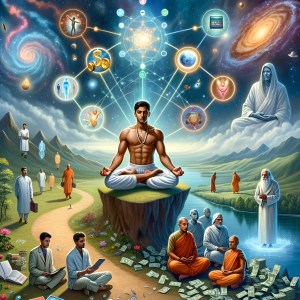
3.Yajnavalkya–Maitreyi Dialogue Part 1
Theme: All love is rooted in the Self; realization of Self leads to immortality.
-
Yajnavalkya prepares to renounce and discusses with Maitreyi.
-
Maitreyi asks if wealth can lead to immortality—he says no.
-
He begins to explain the greatness of Self-knowledge.
-
Everything is dear for the sake of the Self alone.
-
The Self is the root of all perception and love.
-
Knowing the Self, one sees all as the Self.
-
Just as different elements return to their source, all returns to the Self.
-
All relationships and identities dissolve in Self-realization.
-
Without knowing the Self, speech, sight, etc. are in vain.
-
The Self is the light behind all functions.
-
When one sees the Self, duality ceases.
-
Upon Self-realization, nothing else remains to be desired.
-
The Self is self-luminous; it illumines all.
-
Finality is in merging with this infinite Self.
4.Yajnavalkya–Maitreyi Dialogue Part 2
Theme: Nature of the Self, liberation, and cessation of duality.
-
Continuation of Maitreyi’s inquiry into the Self.
-
Yajnavalkya speaks of the Self as beyond birth and death.
-
The Self is not born, does not die, is eternal.
-
Even gods do not see It, but It sees all.
-
It is untouched by karma, changeless.
-
In dream state, the Self creates and dissolves experience.
-
The dream Self shows freedom from physical laws.
-
In deep sleep, the Self merges into bliss.
-
Sleep shows the undifferentiated state of consciousness.
-
The Self neither goes nor returns—it is always present.
-
Death is described as the withdrawal of faculties into the Self.
-
Just as a tree stands when life is present, so the body lives through prana.
-
All limbs function through the Self’s presence.
-
At death, all elements return to their source.
-
Mind, speech, breath—all dissolve into the Self.
-
The individual ceases to be an agent; only Self remains.
-
The Self is untouched by good or evil.
-
Liberation is freedom from doership and enjoyership.
-
The Self exists alone—beyond all dualities.
-
At realization, individuality disappears.
-
The liberated one becomes Brahman.
-
Maitreyi is amazed and silent.
-
Yajnavalkya concludes the teaching.
-
The final instruction: Self alone is to be known.
-
This is the highest knowledge—leads to immortality.
Join Our Classes:
The Upanishads are more than just ancient texts—they are timeless guides to living with clarity, balance, and inner peace. Our classes make their profound wisdom easy to understand and apply in everyday life. Join us to explore these teachings and discover a new way of seeing yourself and the world!