Brihadaranayaka Upanishad – First Brahmana of the Madhu Khanda
Brahmana 1: The Horse-Sacrifice (Ashvamedha Brahmana)
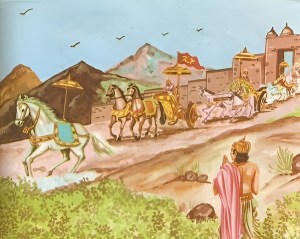
This section uses symbolic imagery of a sacrificial horse to describe the cosmic structure.
- The dawn, the year, and the horse symbolize time and the cosmos in ritual; the horse represents the entire universe.
-
Various parts of the horse are identified with cosmic elements like fire, wind, and the sun, signifying unity of being.
-
The inner world and outer world are mirrored in the horse’s limbs, representing interconnectedness.
-
The horse’s breath and voice are likened to the gods, symbolizing the divine life-force within all.
-
The mouth and speech of the horse are associated with fire and Indra, pointing to creation through sound.
-
The horse’s limbs reflect time divisions, emphasizing the cyclical nature of existence.
-
The horse’s features are aligned with Vedic deities, uniting ritual with cosmic forces.
-
The horse’s tail and back are connected to the heavens and lightning, symbolizing divine presence.
-
The horse’s joints and limbs represent specific gods and regions, reinforcing cosmic correspondence.
-
The horse’s breath and movements are identified with Vāyu (wind) and directions, showing life’s flow.
-
Ritual actions toward the horse are not just symbolic but affirm cosmic truth and order (ṛta).
-
The horse’s organs correspond to elements of the ritual, emphasizing inner-outer integration.
-
The binding of the horse represents binding the cosmos in unity and order through sacrifice.
-
Offering the horse to the gods is a way of returning the universe to its source.
-
The entire sacrifice reflects the unity of creation, ritual, time, and Self.
Brahmana 2: The Origin of Beings
This section explains how beings and elements originated from Brahman, the Self.
-
In the beginning, only the Self (Ātman) existed; from it, all beings and the universe emerged.
-
The Self desired companionship and created the world through duality—man and woman.
-
Creation expanded as the Self became multiple forms through the union of opposites.
-
Hunger and thirst arose, leading to the search for food and sustenance in the material world.
-
The Self entered creation, identifying with it, thus becoming the experiencer in all beings.
-
The Self is the life in breath (prāṇa) and functions through speech, sight, and hearing.
-
The Self distributed functions among the gods and became their inner controller (antaryāmin).
-
The gods tried to claim supremacy, but only through the Self did their powers work.
-
The Self enabled the deities to overcome evil, proving its hidden supremacy.
-
The Self is unknowable by the senses but is that which makes them function.
-
Those who know the Self as the inner controller realize the unity behind all diversity.
-
The Self cannot be seen or grasped, but is the unseen seer, the unheard hearer.
-
Knowing this Self leads to immortality; all else is transient and perishable.
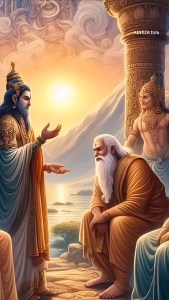
Brahmana 3: The Dialogue of Yājñavalkya and the Priests (Part 1)
This section begins a famous philosophical dialogue with sage Yājñavalkya, exploring ritual and inner knowledge.
-
King Janaka holds a yajña (sacrifice), and many learned Brahmins gather to debate spiritual truths.
-
Yājñavalkya arrives and hints he’s ready to challenge everyone to win the king’s reward of cows.
-
The priests, curious and slightly provoked, begin questioning Yājñavalkya to test his knowledge.
-
Ashvala asks about the purpose of sacrificial offerings; Yājñavalkya says they’re made for different gods.
-
He clarifies that all these gods are ultimately aspects of the one Self.
-
Asked who controls the offerings, Yājñavalkya answers: the vital breath (prāṇa) within, the inner Self.
-
The breath is called “truth” (satya) because it upholds and sustains all life.
-
Yājñavalkya explains that prāṇa leads speech, breath, and body, making life possible.
-
Ashvala asks what remains when everything merges back at death—Yājñavalkya says: the Self alone remains.
-
The body, senses, and mind dissolve, but the Self is untouched and eternal.
-
The Self is not born nor does it die—it is the observer, the eternal witness.
-
Ashvala asks about the path of liberation; Yājñavalkya says only those who know the Self attain it.
-
Rituals are useful only when supported by Self-knowledge; otherwise, they are limited in power.
-
The dialogue subtly shifts toward revealing the supremacy of knowledge over action.
Brahmana 3: The Dialogue of Yājñavalkya and the Priests (Part 2)
Yājñavalkya continues answering profound questions about life, death, and the inner Self.
-
The gods overcame evil through the power of the Self within them, not by their own strength.
-
The Self is the ultimate source of all divine powers; it operates silently within all.
-
The Self is not limited by ritual or knowledge—it transcends them and illuminates them.
-
Each organ, like the eye or ear, depends on the Self for its function.
-
Without the Self, none of the faculties work; it is the hidden controller (antaryāmin).
-
Even speech and thought are possible only through the presence of the Self.
-
The Self is pure consciousness, unaffected by actions or emotions.
-
Yājñavalkya says, one who realizes this Self becomes fearless and free.
-
Those who see duality go from death to death, trapped in ignorance.
-
The Self is all-pervading, but remains unaffected and unchanged, like space.
-
Liberation comes when one sees no other, hears no other, knows nothing but the Self.
-
Even gods and sages seek this Self, for it is the essence of all.
-
One who knows “I am Brahman” becomes everything and transcends all limitations.
-
Yājñavalkya’s wisdom stuns the assembly; his answers point directly to non-dual Self-realization.
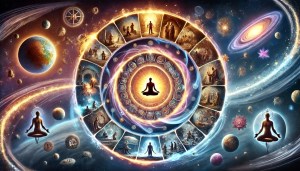
Brahmana 4: The Self and the Origin of the World
This section explores the evolution of the universe from the Self and the fundamental nature of individuality and duality.
-
In the beginning, the Self (Ātman) alone existed; from it, all things—gods, beings, and worlds—emerged.
-
The Self became afraid being alone, but then realized there was nothing else to fear.
-
To overcome loneliness, the Self created a second by dividing itself into male and female.
-
From this duality, all living beings were born through the union of opposites.
-
The Self also became animals and various life forms to experience all modes of existence.
-
Everything is a projection of the Self; gods and demons alike are expressions of it.
-
He who realizes the Self in all beings transcends individuality and becomes one with everything.
Brahmana 5: The Primacy of the Self
This section emphasizes that all the faculties and deities operate only through the power of the Self.
-
The Self empowers all deities; without the Self, none of the gods can function.
-
The senses and elements are guided by the Self, the unseen ruler within.
-
Just as horses are controlled by a driver, all faculties are governed by the Self.
-
The Self, though hidden, enables sight, hearing, thinking, and action.
-
Realization of the Self grants immortality; all else leads only to impermanence.
-
The Self is not known by sense-objects but by knowing the knower behind them.
-
Even gods are unaware of the Self unless they seek it within.
-
One who knows the Self becomes fearless, free from duality and confusion.
-
The Self is untouched by good or evil; it is pure, beyond all acts.
-
Just as a razor is hidden in its case, the Self is hidden in the body.
-
Ignorance creates separation; knowledge reveals unity with the eternal Self.
-
Knowing “I am the Self” destroys all fear and leads to liberation.
-
Even while acting in the world, the knower of the Self remains untouched.
-
The Self is neither born nor does it die; it is eternal and beyond decay.
-
He who sees all beings in the Self and the Self in all beings attains completeness.
Brahmana 6: The Glory of the Self
Though short, this section emphasizes the sacredness and inner radiance of the Self.
-
All things, including gods, are rooted in speech, but speech itself arises from the Self.
-
Knowing the Self as the source of everything leads to the highest illumination and fulfillment.
Join Our Classes:
The Upanishads are more than just ancient texts—they are timeless guides to living with clarity, balance, and inner peace. Our classes make their profound wisdom easy to understand and apply in everyday life. Join us to explore these teachings and discover a new way of seeing yourself and the world!