Brihadaranayaka Upanishad – Yajnavalkya Muni Khanda – Chapter 4
Brahmana 1: Yajnavalkya and Asvala
- Janaka offers a prize for the best knower of Brahman; Yajnavalkya steps forward.
- Asvala questions Yajnavalkya about the role of sacrifice and praṇa.
- Yajnavalkya says the offering is made to prana, the chief deity within.
- He adds that sacrifice helps the soul travel through bright paths.
- Asvala asks what leads the soul beyond this world.
- Yajnavalkya affirms that praṇa, as the fire within, guides the soul onward.
Brahmana 2: Dialogues with Various Sages
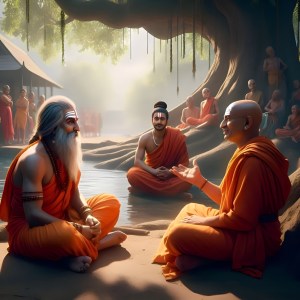
- Artabhaga asks what remains when the soul departs the body.
- Yajnavalkya explains that the Self merges into its source, not seen again.
- The senses return to their origins; only the Self is untouched.
- The Self departs like a shadow vanishing in darkness.
- Uddalaka questions about the soul and the senses.
- Yajnavalkya explains the Self as the root of all sensory experiences.
Brahmana 3: The Deep Sleep and Immortality Teaching
- The Self is beyond waking and dreaming, present in deep sleep.
- In sleep, all distinctions dissolve; only the Self remains.
- The Self desires nothing, sees no dreams in deep sleep.
- That state is blissful; the Self alone is fulfilled.
- The body and senses rest, but the Self continues.
- In deep sleep, prāṇa functions alone to sustain life.
- Dreams are shaped by past actions and impressions.
- The dream Self projects inner images like a painter.
- Everything seen in dreams arises from the Self alone.
- Upon waking, the Self returns with its faculties intact.
- The Self witnesses all three states: waking, dream, and sleep.
- In death, the Self withdraws like in deep sleep.
- The soul, taking subtle impressions, departs the body.
- It follows karmic paths — light or dark — after death.
- The wise transcend both paths and merge into Brahman.
- He who knows the Self overcomes death and rebirth.
- When prāṇa departs, the Self departs with it.
- Vital forces dissolve into their elements at death.
- The Self’s departure determines the next birth.
- The senses follow the departing Self like bees to a hive.
- The Self carries karma from body to body.
- The wise seek to know this Self directly.
- The Self is unborn, unaging, undying, and immortal.
- No weapon, fire, or water can harm it.
- The Self is indivisible and cannot be destroyed.
- The ignorant go to sorrow; the knower goes to freedom.
- He who sees the One behind many becomes liberated.
- The Self is ever-free, untouched by sin or good.
- These verses expound Self as formless, actionless, beyond qualities and eternal.
Brahmana 4: Realization and Liberation
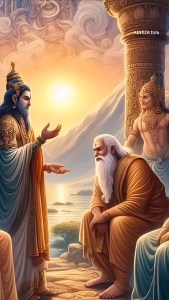
- Janaka asks Yajnavalkya for further instruction on the Self.
- Yajnavalkya says the Self is not seen or touched but is the seer and knower.
- The Self is immutable, without body, nerve, or senses.
- It is beyond good and evil, unaffected by karma.
- Knowing this Self leads to freedom from sorrow.
- Just as a snake sheds skin, the soul leaves the body untouched.
- One who knows the Self becomes pure, stainless, and immortal.
- The Self is not born and does not die; it is eternal.
- It is not slain when the body is slain.
- Like rivers merging into the sea, the Self merges into Brahman.
- Desires cause rebirth; freedom from desires leads to immortality.
- When desires are destroyed, the Self becomes one with Brahman.
- In deep sleep, the Self is blissful and free from duality.
- He who knows this is fearless and immortal.
- The Self is unknowable by the senses or mind.
- It is known only as “neti, neti” – not this, not this.
- It is beyond cause and effect, beyond thought and speech.
- It is the eternal witness, untouched by actions.
- One who knows the Self becomes Brahman and is liberated.
- The Self is not many; it is the One behind all.
- As fire pervades all fuel, the Self pervades the body.
- He who knows the Self gives up the body and becomes immortal.
-
Such a knower becomes the fearless, desireless, blissful Brahman.
Brahmana 5: Yajnavalkya and Maitreyi
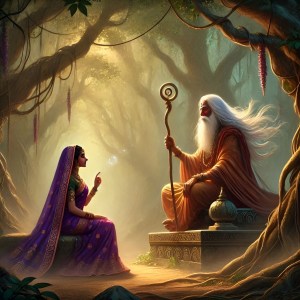
- Yajnavalkya prepares to renounce worldly life and speaks to Maitreyi.
- She asks if wealth can bring immortality; he says no.
- All things are dear not for their own sake, but for the Self.
- Husband, wife, children, and possessions are loved for the Self.
- The Self is the source of all love and value.
- When the Self is known, all becomes known.
- One should know the Self to attain fulfillment.
- Everything is pervaded by the Self, which is pure consciousness.
- The Self is indivisible, beyond duality and differentiation.
- In deep realization, all distinctions dissolve into unity.
- Ignorance creates multiplicity; knowledge reveals oneness.
- All beings merge into the Self like salt in water.
- The Self is not an object of perception but the perceiver.
- The knower of the Self becomes Brahman and transcends death.
- Maitreyi listens in silence, overwhelmed by the depth of truth.
Brahmana 6: Ajatasatru and Balaki
- Balaki approaches King Ajatasatru, claiming to teach Brahman.
- Balaki offers symbolic interpretations of Brahman in nature.
- Ajatasatru dismisses them, saying they are partial truths.
- The king takes Balaki to observe a sleeping man.
- He asks: “Where is the Self during deep sleep?”
- Balaki cannot answer; Ajatasatru explains that the Self withdraws into itself.
- The Self in deep sleep is blissful and one with Brahman.
- It is not through intellect but realization that Brahman is known.
- All symbolic knowledge must culminate in direct experience.
- The Self is beyond physical, mental, and sensory concepts.
- Balaki accepts his ignorance and falls silent.
- The true teacher is one who knows the Self experientially.
- The teaching ends with the silence of realization — the highest wisdom.
Join Our Classes:
The Upanishads are more than just ancient texts—they are timeless guides to living with clarity, balance, and inner peace. Our classes make their profound wisdom easy to understand and apply in everyday life. Join us to explore these teachings and discover a new way of seeing yourself and the world!