What is Ganapati Atharvashirsha Upanishad?
The Ganapati Atharvashirsha Upanishad is a sacred Sanskrit text dedicated to Lord Ganesha, originating from the Atharva Veda. It proclaims Ganesha as the Supreme Reality (Brahman), identifying Him with all deities and the ultimate cosmic principle. This Upanishad reveals the spiritual significance behind Ganesha’s form and attributes, linking them to deeper Vedic truths. Through powerful mantras, like “Om Gam Ganapataye Namah”, it offers seekers a path to wisdom, clarity, and inner realization. It is highly revered in the Ganapatya tradition, where Ganesha is seen not just as a deity, but as the eternal Self. Chanting it is believed to remove obstacles and bring success in both spiritual and worldly pursuits. For More Information Click Here

Key Themes of the Ganapati Atharvashirsha Upanishad:
1. Ganesha as Brahman (Supreme Reality)
-
Ganesha is identified with Brahman, the eternal, formless, and all-pervading consciousness.
-
Declares: “You are the Truth (Sat), Consciousness (Chit), and Bliss (Ananda).”
2. Unity of All Deities
-
Ganesha is described as the embodiment of all divine forms:
“You are Brahma, Vishnu, Shiva, Indra, Agni…”
3. Self as Ganesha
-
Affirms non-duality by stating that Ganesha is the Self (Ātman) in all beings.
-
“You are the Self of all, present in everyone.”
4. Power of the Mantra
-
Introduces the sacred Bija mantra:
“Om Gam Ganapataye Namah”
– a powerful sound vibration invoking Ganesha’s blessings.
5. Symbolism of Ganesha’s Form
-
Explains the symbolic meaning of Ganesha’s physical features (elephant head, tusks, ears, etc.) in relation to cosmic principles and the Om sound.
6. Meditation on Om
-
Links Ganesha to the Pranava (Om), the primordial sound and the essence of the Vedas.
-
Encourages meditation on Om as a means to realize the Self.
Adi Shankaracharya’s Interpretation of the Ganapati Atharvashirsha Upanishad
Adi Shankaracharya did not leave behind a direct commentary on the Ganapati Atharvashirsha Upanishad, as he primarily focused on major Upanishads like the Isha, Kena, Katha, Mundaka, and others that form the core of Vedanta philosophy. However, through his broader teachings and Advaita Vedanta perspective, we can interpret the essence of this Upanishad in the light of his philosophy.
Here’s how Adi Shankaracharya’s Advaita Vedanta would interpret the Ganapati Atharvashirsha Upanishad:
1. Ganesha as Brahman (Non-Dual Reality)
-
The Upanishad declares Ganesha as Brahman, the ultimate non-dual reality, which aligns with Shankara’s core teaching that everything is Brahman – “Brahma satyam, jagat mithya”.
-
Statement like “tvam brahmaasi” (You are Brahman) matches the mahavakyas of the Vedas.
2. Atman = Brahman = Ganesha
-
The Upanishad states: “You are the Self (Atman).”
This is central to Shankara’s teaching: the individual self (Atman) is identical to Brahman. -
So, worship of Ganesha becomes a means to realize the divine Self within.
3. Saguna to Nirguna
-
Ganesha, though worshipped in form (saguna), is ultimately shown to be formless (nirguna).
-
This follows Shankara’s view that form-worship is a valid starting point, but ultimate liberation comes from realizing the formless Self.
4. Use of Mantras and Meditation
-
Shankara emphasized Jnana Yoga (path of knowledge) but also approved mantra japa and bhakti as preparatory aids.
-
The mantra “Om Gam Ganapataye Namah” purifies the mind and leads to inner stillness, a necessary step toward self-realization.
5. Symbolism and Inner Meaning
-
The elephant head, large ears, broken tusk, etc., are rich in symbolic meaning.
-
Shankara would encourage seekers to look beyond the literal form to understand their inner, spiritual significance, using viveka (discrimination).
In summary, while Shankaracharya may not have directly commented on this Upanishad, its message aligns closely with his vision of non-duality, inner realization, and the unity of the Self with the Absolute. Worshipping Ganesha, in this light, is ultimately a meditative path to realizing the Self as pure consciousness.
Summary of 29 Verses in Ganapati Atharvashirsha Upanishad
The 29 verses of the Ganapati Atharvashirsha Upanishad offer a deep spiritual revelation of Lord Ganesha as the embodiment of Brahman, the ultimate reality. The text begins with a salutation and proceeds to identify Ganesha with all deities and cosmic functions, declaring him the Self within all beings. It reveals the bija mantra “Gam” and links Ganesha to the sacred sound Om, emphasizing his presence in all aspects of existence. The Upanishad also describes the symbolic significance of Ganesha’s form and prescribes meditative worship. It encourages seekers to go beyond external forms and realize the non-dual essence. Overall, it blends devotion, mantra, and Vedantic wisdom into a unified spiritual path. For More Information Click Here
Verses
-
Salutation to Ganesha, the remover of obstacles.
-
Proclaims Ganesha as Brahman, the eternal truth.
-
Identifies Ganesha with all gods and cosmic functions.
-
Declares Ganesha as the form of consciousness, bliss, and existence.
-
Describes Ganesha as the inner Self (Atman) in all beings.
-
Explains Ganesha as the origin of the Vedas, speech, and creation.
-
Reveals the Bija mantra “Gam” as Ganesha’s essence.
-
Describes “Om Gam Ganapataye Namah” as the key mantra.
-
Introduces Ganesha Gayatri Mantra for inner illumination.
-
Explains the symbolic meaning of Ganesha’s form and features.
-
Identifies Ganesha with the five elements and creation.
-
Shows his presence in all time and directions.
-
Declares Ganesha as the essence of Omkara (Om).
-
Describes how to meditate on Ganesha’s form.
-
Mentions the benefits of meditating on Ganesha.
-
Assures success and wisdom through his worship.
-
Affirms that one becomes free of sin by his devotion.
-
Says the mantra grants knowledge, wealth, and liberation.
-
Emphasizes daily repetition of the Upanishad for results.
-
Grants purity of mind and spiritual elevation.
-
Promises the removal of obstacles for the devotee.
-
Declares Ganesha as the supreme guide of seekers.
-
Explains the correct pronunciation of the sacred mantras.
-
States the Upanishad’s secrecy and sacredness.
-
Warns it should only be shared with the worthy and devoted.
-
Declares that even listening to it brings spiritual merit.
-
Affirms it as the essence of the Atharva Veda.
-
States the benefits of writing, reading, and preserving it.
-
Concludes with peace mantras (Shanti Patha) for harmony and balance.
Why Ganapati Atharvashirsha Upanishad Important?
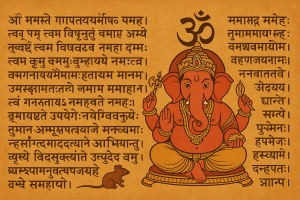
The Ganapati Atharvashirsha Upanishad is important because it reveals Lord Ganesha not just as a deity, but as the Supreme Brahman, the formless, eternal reality described in Vedanta. It connects devotion (bhakti) with knowledge (jnana) by showing that worshipping Ganesha can lead to Self-realization. The Upanishad includes sacred mantras like “Om Gam Ganapataye Namah”, which are powerful tools for meditation, spiritual growth, and removal of obstacles. It bridges the symbolic form of Ganesha with deep philosophical meaning, making it both accessible and profound. For seekers, it offers a complete spiritual path combining mantra, meditation, and Vedantic wisdom in one concise text.
Conclusion
In conclusion, the Ganapati Atharvashirsha Upanishad stands as a unique spiritual scripture that unites devotion, mantra, and Vedantic philosophy. It elevates Lord Ganesha from a beloved deity to the highest reality—Brahman and Atman—emphasizing that the divine dwells within all. Through its powerful verses and sacred mantras, it offers seekers a clear path to inner purity, wisdom, and liberation. Whether chanted with faith or meditated upon with understanding, this Upanishad continues to inspire and guide those on the journey toward self-realization and spiritual fulfillment.
Join Our Classes:
The Upanishads are more than just ancient texts—they are timeless guides to living with clarity, balance, and inner peace. Our classes make their profound wisdom easy to understand and apply in everyday life. Join us to explore these teachings and discover a new way of seeing yourself and the world!