Essence of the Adhyatma Upanishad: Realization through Self-Inquiry and Inner Renunciation
The Adhyatma Upanishad, affiliated with the Shukla Yajurveda, is a key text that emphasizes the path of Self-inquiry and inner renunciation. It teaches that Brahman alone is real, and the world is a projection of ignorance (avidya). Liberation (moksha) arises not from rituals but from the realization of the Self (Atman) as pure consciousness. The Upanishad outlines the qualities of a true renunciate (sannyasi) and the importance of detachment, discrimination, and meditation. It rejects duality and affirms the Self as unchanging, eternal, and blissful. Ultimately, it guides seekers to dissolve the ego and abide in the non-dual awareness of Brahman. For More Information Click Here
Overview and Structure of the Adhyatma Upanishad
The Adhyatma Upanishad is a minor Upanishad belonging to the Shukla Yajurveda and classified under the group of Sannyasa Upanishads—texts that focus on renunciation (sannyasa), Self-realization, and Advaita Vedanta (non-duality).
It is primarily a spiritual dialogue that outlines the nature of the Self (Atman), the illusory nature of the world (maya), and the path to liberation (moksha) through Self-knowledge and inward detachment.
Structure:
- The Adhyatma Upanishad consists of 1 chapter
- It contains approximately 70 verses (slokas)
Despite being brief, the Adhyatma Upanishad is rich in non-dual wisdom and offers clear, practical guidance on how to go beyond ego and ignorance to realize the eternal, blissful Self.

Core Teachings of the Adhyatma Upanishad: The Inner Path to Self-Realization
The Adhyatma Upanishad offers a clear and direct exposition of Advaita Vedanta, emphasizing the path of Self-inquiry, renunciation, and inner purity. Its teachings guide aspirants away from ritualism and toward the realization of the Self (Atman) as Brahman, the infinite consciousness.
Here are its core teachings:
- Atman is Brahman
The Upanishad affirms the non-dual truth that the individual Self (Atman) is identical with the Supreme Reality (Brahman)—eternal, pure, and free. - The World is Illusory (Maya)
The phenomenal world is described as unreal, a projection of ignorance. True vision arises when one sees beyond the forms and names to the formless Self. - Self-Knowledge is Liberation
Moksha (liberation) is not attained through rituals, mantras, or external disciplines, but through direct realization of one’s true nature as unchanging consciousness. - Qualities of a True Renunciate
A sannyasi, according to this text, is one who has renounced the ego, lives in stillness, and is free from identification with body or mind. - Discipline and Detachment are Essential
The Upanishad underscores viveka (discrimination), vairagya (dispassion), and self-control (shama, dama) as essential tools for the seeker. - Abidance in the Self
True realization is abiding in one’s own nature—without thought, effort, or duality. It is a natural resting in pure being, untouched by desire or action.
In essence, the Adhyatma Upanishad teaches that liberation is not something to be gained, but rather the recognition of what one already is—limitless, formless, and ever free. For More Information Click Here
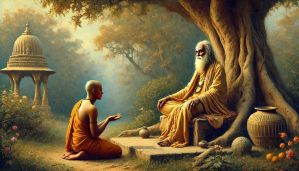
Authorship and Vision of the Adhyatma Upanishad: Teachings of Sage Dattatreya
Like most ancient Upanishads, the Adhyatma Upanishad is considered apauruṣeya—not attributed to any single human author, as it is believed to be a timeless revelation (śruti) received by sages through deep meditation and spiritual realization.
Attributed Teacher: Sage Dattatreya
- The teachings of the Adhyatma Upanishad are traditionally ascribed to Sage Dattatreya, a legendary sage revered as an incarnation of the Divine Trinity—Brahma, Vishnu, and Shiva.
- Dattatreya is seen as the embodiment of the Avadhuta, a liberated being who has transcended all worldly limitations and lives in the constant awareness of Brahman.
Dattatreya’s Vision and Insights in the Upanishad:
- Liberation Through Self-Knowledge:
Dattatreya’s teachings focus on the idea that Self-realization alone is moksha, and external rituals or scriptural study without inner experience are inadequate. - Rejection of Duality:
He affirms the non-dual nature of reality, where there is no distinction between the Self and Brahman, between seeker and sought. - Renunciation as Inner Detachment:
True renunciation, according to him, is not physical withdrawal but the mental renunciation of ego and doership, leading to inner stillness. - Meditative Abidance in the Self:
He emphasizes effortless awareness and abidance in one’s own true nature as the final stage of spiritual evolution.
In conclusion, the Adhyatma Upanishad, through the voice of Sage Dattatreya, presents a crystal-clear path of Self-inquiry, dispassion, and non-duality, offering a universal teaching that remains deeply relevant to seekers of all times.

Importance of the Adhyatma Upanishad: A Guide to Inner Realization and Non-Dual Truth
The Adhyatma Upanishad is a highly significant spiritual text, especially for seekers on the path of Jnana Yoga and Advaita Vedanta. Though concise, it conveys powerful insights into the nature of reality, the illusion of ego, and the direct means to attain liberation.
Key Points Highlighting Its Importance:
- Direct Path to Liberation
The Upanishad emphasizes that Self-realization alone is liberation, bypassing elaborate rituals and promoting inner experience over external practice. - Clarity in Advaita Vedanta
It presents non-dualism (Advaita) in a lucid and accessible way, teaching that Atman and Brahman are one, and all forms of duality are mere illusions. - Practical Guidance for Renunciates and Seekers
It outlines the qualities of a true renunciate (sannyasi)—inner detachment, equanimity, dispassion—and offers practical steps for living in awareness of the Self. - Bridges Jnana and Yoga
While grounded in jnana (knowledge), the text also harmonizes with yogic ideals like meditation, inner control, and dissolution of the ego. - Universality of Its Message
The teachings are timeless and universal—relevant to all sincere seekers, regardless of sect or background, pointing directly to the ever-present, non-dual Self.
In essence, the Adhyatma Upanishad holds enduring importance as a concise manual for spiritual awakening, guiding aspirants to transcend ignorance and realize their true nature as pure, infinite consciousness. For More Information Click Here
Conclusion
The Adhyatma Upanishad serves as a profound spiritual guide for those seeking liberation through Self-knowledge. With its clear emphasis on non-duality, inner renunciation, and direct realization of the Self, it strips away the complexities of ritualistic religion and reveals the essence of true spirituality. Attributed to Sage Dattatreya, its timeless teachings encourage seekers to abandon ego, transcend illusion, and abide in the ever-free, eternal Self. As a concise yet powerful Upanishad, it continues to illuminate the path of Advaita Vedanta, making it a treasured text for serious aspirants of truth.
Join Our Classes:
The Upanishads are more than just ancient texts—they are timeless guides to living with clarity, balance, and inner peace. Our classes make their profound wisdom easy to understand and apply in everyday life. Join us to explore these teachings and discover a new way of seeing yourself and the world!