What is Prasno Upanishad ?
The Prasno Upanishad is one of the important Upanishads, belonging to the Atharva Veda. It presents a dialogue between six earnest seekers and the sage Pippalada. Each disciple approaches the sage with deep philosophical questions about the nature of creation, life, and the supreme reality, Brahman. The Upanishad is structured in six sections, each dealing with one profound question and its insightful answer. It explores topics like the origin of life, the role of prana (vital energy), and the significance of meditation on “Om”. Through these teachings, it guides seekers towards understanding the ultimate truth and the path to liberation. For More Information Click Here

Key Teachings of Prasno Upanishad
-
Supreme Role of Prana (Life Force): Prana is described as the vital energy that sustains life and supports all physiological functions in the body. It is considered the chief among all senses and energies.
-
Creation and Origin of Beings: The Upanishad explains how the universe and living beings originate from the Supreme Being (Brahman). It teaches that everything comes from and returns to that ultimate source.
-
Meditation on Om (Aum): Chanting and meditating on “Om” is shown as the path to attain Brahman. Different levels of realization are attained depending on how deeply one meditates upon Om.
-
Nature of the Self (Atman): The Upanishad guides seekers to understand the true nature of the Self as eternal, beyond birth and death, and identical with Brahman.
-
The Journey After Death: It describes how the fate of an individual soul after death depends on knowledge, actions, and meditation on Om. Those with higher knowledge reach Brahman, while others return to the cycle of birth and death.
-
Importance of Faith and Discipline: True understanding and spiritual knowledge require faith, self-discipline, and a sincere quest for truth, as exemplified by the students who approach Sage Pippalada with humility and devotion.
Adi Shankaracharya’s teachings on the Prasno Upanishad
Adi Shankaracharya’s commentary on the Prasno Upanishad highlights its deep philosophical insights and explains the non-dualistic (Advaita) understanding of Brahman. He emphasizes that the Upanishad teaches Brahman as the ultimate, formless reality, beyond all duality. Shankaracharya explains that Prana, though vital and powerful, is not the Supreme Self but a manifestation of Brahman within the body. He clarifies that meditation on Om leads the seeker progressively towards realization, depending on the depth of contemplation—ultimately merging the individual self (Atman) with Brahman. His commentary stresses that true liberation (moksha) comes only from Self-knowledge (Atma Jnana), realizing that the individual self is not different from the Supreme Self. Shankaracharya also underlines the necessity of faith, devotion, and a disciplined life as prerequisites for attaining this highest knowledge.
Summary of 67 Verses in Prasno Upanishad
The Prasno Upanishad, comprising 67 mantras, presents a dialogue between Sage Pippalada and six seekers who ask profound questions about creation, life, and the ultimate reality. It explains how all beings originate from Brahman and how Prana (life force) sustains life. The Upanishad describes the role of the senses and the importance of Prana as the chief among them. It highlights meditation on Om as the key to different levels of realization, leading ultimately to union with Brahman. The teachings guide seekers to understand the nature of the Self (Atman) and the path to liberation. Faith, discipline, and knowledge are emphasized as essential for attaining the highest truth. For More Information Click Here
Verse-by-Verse Essence of the Prasno Upanishad
- Meditation on the Self grants supreme bliss.
- The three states are mere appearances in the Self.
- Liberation comes from realizing the Self beyond waking, dreaming, and sleep.
- Satyakama inquires about the effects of meditation on Om.
- Meditation on Om leads to different levels of attainment.
- Those who meditate on one syllable (A) reach the world of men.
- Meditation on two syllables (AU) leads to the world of celestial beings.
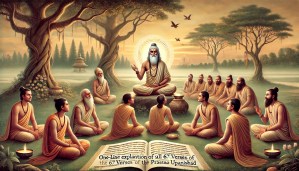
- Six students approach Sage Pippalada with devotion for knowledge of Brahman.
- The sage asks them to observe celibacy, faith, and austerity for a year.
- Kabandhi asks about the origin of creation.
- Sage Pippalada explains that Prajapati (the Creator) manifested Rayi (matter) and Prana (energy).
- These two are the cause of all beings: matter forms the body; prana sustains life.
- Prajapati created the moon from Rayi and the sun from Prana.
- The sun (Prana) supports all life; the moon nourishes beings through food.
- The sun sustains the world by rising and setting in the east and west.
- The divine Prana gives rise to rain, which sustains food and beings.
- Beings are created from the union of Prana (father) and Rayi (mother).
- Whoever practices austerity and knowledge attains divine worlds.
- Ignorant beings return to earthly existence.
- Prajapati presides over Prana and Rayi in both subtle and gross forms.
- The wise meditate on these principles to understand the cosmic process.
- Prana governs both the inner and outer aspects of existence.
- Those who understand this truth become immortal.
- Bhargava inquires about the source and power of Prana.
- Sage explains Prana emerges from the Self (Atman) like a shadow.
- Prana divides itself into fivefold energy to perform various functions.
- Prana resides in the heart and circulates through the senses.
- The lower Pranas govern different bodily functions.
- The main Prana sustains the head and body.
- The soul departs through the main Prana at death.
- Prana is the fire that energizes all bodily functions.
- The Pranas honor the main Prana as their leader.
- The sense organs compete to prove their importance.
- Prana demonstrates its supremacy by withdrawing, disabling all others.
- The sense organs recognize Prana as their essential support.
- Prana nourishes and sustains all beings.
- Worship of Prana brings health, vitality, and long life.
- Kausalya asks how Prana sustains the body and where it resides.
- Prana is born from the Self and resides in the heart.
- From the heart, it moves through various channels to vital organs.
- Prana supports speech, sight, hearing, and thinking.
- The lower Pranas govern digestion, elimination, and circulation.
- At death, Prana merges into the mind and departs with the soul.
- The soul’s destination depends on karma and knowledge.
- Prana leads the soul through the subtle path after death.
- The wise who realize the Self transcend rebirth.
- Those ignorant of the Self return to worldly existence.
- Prana is the bridge between body and mind.
- Knowledge of Prana and Atman grants liberation.
- Gargya asks about the significance of the waking, dreaming, and deep sleep states.
- The Self is conscious in the waking state through the senses.
- In dreaming, the mind creates its own experiences.
- In deep sleep, the Self rests in bliss, unaware of the external world.
- The Self is the ultimate witness beyond all states.
- The wise know the Self is changeless, even as the states change.
- Realizing the Self leads to freedom from fear and sorrow.
- The Self transcends the body, mind, and senses.
- Meditation on the full Om (AUM) brings union with Brahman.
- Each level grants progressive realization, depending on meditation.
- The supreme attainment is merging with Brahman beyond all worlds.
- Sukesha asks about the Purusha (Supreme Person) in the heart.
- Sage describes the Purusha as radiant like the sun, beyond sin and suffering.
- This Purusha rules over the body and mind from the heart.
- He is the source of all energy, knowledge, and action.
- Meditation on this inner Purusha grants immortality.
- He is the eternal witness, untouched by body and mind.
- Knowing this Supreme Person, the seeker attains liberation and bliss.
Significance of the Prasno Upanishad
The Prasno Upanishad is important because it addresses some of the most fundamental spiritual questions about life, creation, and the nature of the Self. Through a dialogue between Sage Pippalada and six sincere seekers, it explores deep concepts like the origin of the universe, the role of Prana (life force), and the significance of Om in meditation. It guides spiritual aspirants toward self-realization and liberation (moksha) by revealing the oneness of the individual soul (Atman) with the supreme reality (Brahman). The Upanishad emphasizes the need for faith, discipline, and knowledge, making it a key text for understanding Advaita Vedanta philosophy and the path to ultimate truth.

Conclusion
The Prasno Upanishad offers profound insights into the nature of life, creation, and the supreme reality, Brahman. Through its six questions and answers, it guides seekers on the path of self-inquiry and spiritual knowledge. Emphasizing the importance of Prana, meditation on Om, and realization of the Self, it shows the way to liberation (moksha). This Upanishad remains a timeless source of wisdom for those seeking the ultimate truth.
“Brahma satyam jagat mithya, jivo brahmaiva na aparah.”
“Brahman alone is real; the world is illusory, and the individual self is none other than Brahman.”
Join Our Classes:
The Upanishads are more than just ancient texts—they are timeless guides to living with clarity, balance, and inner peace. Our classes make their profound wisdom easy to understand and apply in everyday life. Join us to explore these teachings and discover a new way of seeing yourself and the world!