Introduction
The Muṇḍaka Upanishad is one of the major Upanishads, belonging to the Atharva Veda. Its name “Muṇḍaka” (meaning “shaved” or “shaven-headed”) signifies a text meant especially for renunciates, indicating its emphasis on higher knowledge that leads to liberation. Composed in poetic verse, it consists of three parts (muṇḍakas), each subdivided into two sections, making a total of six chapters. The text is renowned for its clear distinction between higher knowledge (parā vidyā), which leads to Self-realization, and lower knowledge (aparā vidyā), which covers rituals, scriptures, and worldly sciences. It is also the source of the famous metaphor of “two birds on the same tree,” illustrating the relationship between the individual self (jīva) and the supreme Self (Ātman/Brahman). The Muṇḍaka Upanishad is both poetic and deeply philosophical, laying out the path to immortality through knowledge and detachment. Click Here To More Detail.
Themes
From the summary in the text, here are the main themes of the Muṇḍaka Upanishad:
Two Kinds of Knowledge
The Upanishad makes a sharp distinction between aparā vidyā (rituals, grammar, sciences) and parā vidyā (knowledge of the imperishable Brahman). Only the latter leads to liberation.
The Imperishable Brahman
It teaches that beyond all names, forms, and changing phenomena lies the eternal, unchanging reality — Brahman — which is the source and ground of the universe.
The Two Birds Metaphor
The Upanishad presents the famous image of two birds on a tree: one eats the fruit (symbolizing the individual experiencing pleasure and pain), while the other simply watches (symbolizing the witnessing Self). Liberation comes when the individual recognizes its oneness with the witnessing Self.
Renunciation and Detachment
Worldly rituals and material pursuits are seen as limited. True seekers are advised to renounce dependence on mere ritualism and turn inward toward the Self.
The Path of Knowledge and Discipline
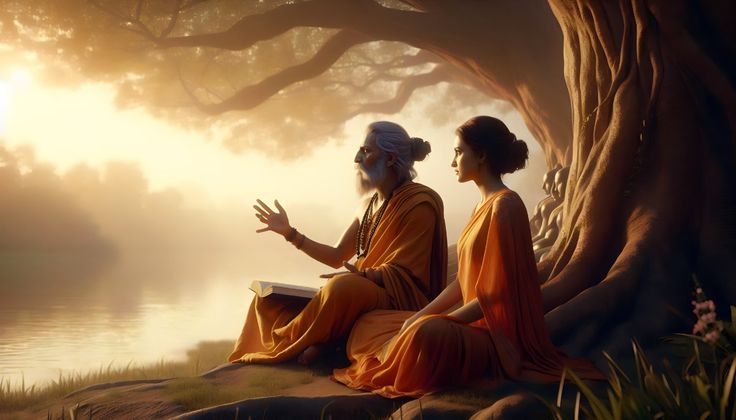
Self-realization requires purity, austerity, truth, meditation, and the guidance of a realized teacher (guru). It emphasizes the spiritual discipline needed to grasp the subtle truth of Brahman.
Liberation and Immortality
By realizing the Self, one transcends death and attains immortality, described as merging with Brahman, like rivers flowing into the sea. Click Here To Mundaka Upanishad.

How to Study It
To study the Muṇḍaka Upanishad effectively, here are some steps:
-
Read with commentary
Compare interpretations from Advaita Vedānta (non-dualism), Vishishtādvaita, and other schools. -
Reflect on the two kinds of knowledge
Ask: how does my pursuit of knowledge relate to what is ultimate? Am I focused on the eternal or only the temporary? -
Meditate on the “two birds” image
Contemplate the witnessing Self within, beyond all experiences of pleasure and pain. -
Compare with other Upanishads
For example, contrast its stress on knowledge over ritual with the Katha Upanishad’s emphasis on the path of discipline, or with the Isa Upanishad’s balance of action and knowledge. -
Apply practically
Practice detachment from results, truthfulness, discipline, and devotion. Recognize the witnessing Self in all beings. Click Here To Mundaka Upanishad.

Why Study It
Studying the Muṇḍaka Upanishad is valuable because:
- It clearly defines the distinction between ritualism and true spiritual knowledge.
- It inspires detachment from superficial pursuits and guides seekers toward the imperishable Self.
- Its metaphors, especially the “two birds,” give vivid imagery for understanding the Self.
- It emphasizes the importance of the guru–disciple relationship in spiritual growth.
- It shaped later Vedāntic traditions, influencing debates on knowledge, meditation, and liberation. Click Here To Mundaka Upanishad.
Conclusion
The Muṇḍaka Upanishad is one of the most poetic and profound expressions of Vedāntic wisdom. It teaches that true liberation is not found in ritual or external learning but in the realization of Brahman, the imperishable reality beyond all change. By distinguishing between higher and lower knowledge, it urges seekers to transcend superficial pursuits and turn to the eternal. Its imagery — such as the two birds and rivers merging into the sea — conveys the journey of the soul toward its union with the infinite. Practical yet deeply philosophical, the Muṇḍaka Upanishad remains a timeless guide for those seeking ultimate freedom and Self-realization.
Join Our Classes:
The Upanishads are more than just ancient texts—they are timeless guides to living with clarity, balance, and inner peace. Our classes make their profound wisdom easy to understand and apply in everyday life. Join us to explore these teachings and discover a new way of seeing yourself and the world!