What is Taittriya Upanishad?
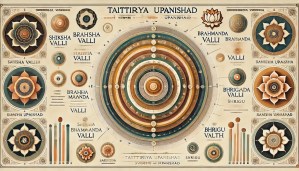
The Taittiriya Upanishad is a sacred text from the Krishna Yajur Veda, exploring the nature of the Self (Atman) and Brahman (the Supreme Reality). It is divided into three chapters: Shiksha Valli, which gives instructions on ethics, education, and right conduct; Brahmananda Valli, which explains the five sheaths (Panchakosha) that cover the true Self; and Bhrigu Valli, which describes sage Bhrigu’s journey of self-discovery through meditation. The Upanishad emphasizes that Brahman is Bliss (Ananda) and that realizing this brings true happiness. It teaches the unity of the individual soul with the universal consciousness. Through ethical living, knowledge, and self-inquiry, the Taittiriya Upanishad guides one toward liberation (moksha). For More Information Click Here
Themes of Taittiriya Upanishad
1. Brahman as the Ultimate Reality
-
- Brahman is the source, support, and essence of the universe.
- It is described as Satyam (Truth), Jnanam (Knowledge), and Anantam (Infinite).
2. The Unity of Atman and Brahman
-
- The individual self (Atman) is not different from Brahman.
- Realizing this unity leads to self-realization and liberation (moksha).
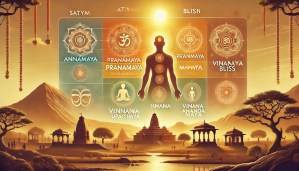
3. Panchakosha (Five Sheaths of Existence)
-
- The journey of self-discovery moves through five layers:
- Annamaya (Physical body)
- Pranamaya (Vital life force)
- Manomaya (Mind)
- Vijnanamaya (Intellect)
- Anandamaya (Bliss)
-
True self is beyond these layers.
- The journey of self-discovery moves through five layers:
4. Brahman as Ananda (Bliss)
-
- Supreme happiness is the nature of Brahman.
- True joy comes from knowing one’s own self as Brahman.
5. Ethical Living and Discipline
-
- The Shiksha Valli emphasizes truth (Satyam), righteous conduct (Dharma), and self-control.
- Moral values and respect for teachers and elders are foundational.
6. Knowledge through Tapas (Meditation and Inquiry)
-
- Bhrigu Valli shows that direct experience through meditation (Tapas) leads to knowledge of Brahman.
- Inquiry and reflection are necessary for self-realization.
Adi Shankaracharya’s Teachings on the Taittiriya Upanishad
Adi Shankaracharya’s teachings on the Taittiriya Upanishad focus on the non-dual (Advaita) nature of Brahman. He explains that the Atman (individual self) and Brahman (universal self) are one and the same, and realizing this unity leads to moksha (liberation). In his commentary, he clarifies the concept of Panchakosha (five sheaths), showing that the true Self lies beyond the body, mind, and intellect, in the state of pure bliss (Ananda). Shankaracharya emphasizes that Brahman is Nirguna (without attributes), infinite, and the cause of all creation. He highlights the importance of self-inquiry (Atma Vichara) and knowledge (Jnana) as the means to liberation. His teachings guide seekers to transcend ignorance and realize the eternal, unchanging reality.
Summary of 31 Verses in Taittiriya Upanishad
The Taittiriya Upanishad consists of 31 mantras (verses) spread across its three sections: Shiksha Valli, Brahmananda Valli, and Bhrigu Valli. In Shiksha Valli, the first 12 verses focus on pronunciation, discipline, meditation, and ethical living, including the famous convocation address promoting truth and dharma. The Brahmananda Valli, with 9 verses, explains the nature of Brahman and the Panchakosha (five sheaths), teaching that the Self is beyond body, mind, and intellect, residing in bliss. The Bhrigu Valli, consisting of 10 verses, narrates Sage Bhrigu’s meditation and realization that Brahman is Ananda (Bliss). These 31 verses guide the seeker from external rituals to inner knowledge, emphasizing self-inquiry and realization of the unity of Atman and Brahman. The Upanishad blends practical living with deep philosophical truths, leading to moksha (liberation). For More Information Click Here
One-Line Summary of All 31 Verses of the Taittiriya Upanishad
Shiksha Valli (Chapters 1–12)
-
- Importance of proper pronunciation (Shiksha) and sound in Vedic learning.
- Invocation for protection and strength for teacher and student.
- Description of the composition of the universe through five elements.
- Meditation on cosmic forces like fire and wind to attain knowledge.
- Meditation on speech, mind, sight, hearing, and breath for spiritual growth.
- The importance of truth, tapas (austerity), and knowledge in realizing Brahman.
- Meditation on the interconnectedness of beings and the universe.
- Prayer for wisdom, power of speech, and protection in learning and teaching.
- Description of the cosmic order and its expression through Vedic rituals.
- Prayer for learning the truth, overcoming ignorance, and attaining peace.
- The famous Shishya Anushasanam—ethical instructions on truth, dharma, and conduct.
- Final meditation invoking peace in all aspects of life and the universe.
Brahmananda Valli (Chapters 1–9)
-
- Introduction to Brahman as Truth, Knowledge, and Infinite.
- Creation emerges from Brahman, the source of everything.
- Description of the first sheath: Annamaya (physical body made of food).
- Second sheath: Pranamaya (life force or vital energy).
- Third sheath: Manomaya (mind and mental processes).
- Fourth sheath: Vijnanamaya (intellect and wisdom).
- Fifth sheath: Anandamaya (bliss and pure joy).
- Realization that the bliss of Brahman transcends all other forms of happiness.
- Brahman as the cause and essence of the universe, existing in everything.
Bhrigu Valli (Chapters 1–10)
-
- Bhrigu asks his father Varuna about Brahman and is instructed to meditate.
- Bhrigu realizes food (Annam) as Brahman but is told to meditate further.
- He meditates again and realizes life-force (Prana) as Brahman, but continues inquiry
- Next, he realizes mind (Manas) as Brahman, yet seeks deeper knowledge.
- He then discovers intellect (Vijnana) as Brahman, but continues seeking.
- Finally, he realizes bliss (Ananda) as the true nature of Brahman.
- Finally, he realizes bliss (Ananda) as the true nature of Brahman
- The benefits of understanding Brahman: prosperity, health, and fulfillment.
- Explains how those who offer food and perform rituals attain Brahman.
- Concludes with the realization that Brahman is the ultimate source of joy and life.

Importance of the Taittiriya Upanishad
The Taittiriya Upanishad holds a vital place in Vedantic philosophy, offering profound teachings on the nature of the Self (Atman) and Brahman (the Absolute Reality). It presents the Panchakosha (five sheaths) framework, which guides seekers from the outer physical body to the innermost core of bliss, revealing the true Self beyond body and mind. Its practical lessons in the Shiksha Valli emphasize ethical living, truthfulness, self-discipline, and respect for teachers and elders, forming the foundation for spiritual growth. The Brahmananda Valli explores Brahman as infinite bliss and consciousness, while the Bhrigu Valli demonstrates the path of self-inquiry and meditation through the story of Sage Bhrigu. Adi Shankaracharya’s interpretation of this Upanishad underscores its Advaita Vedanta message—that Atman and Brahman are one. By combining spiritual knowledge with practical guidance for life, the Taittiriya Upanishad serves as a roadmap to inner peace, self-realization, and liberation (moksha).
Conclusion
In conclusion, the Taittiriya Upanishad offers a profound journey from external knowledge to inner realization. It teaches that the ultimate truth lies in understanding the oneness of Atman and Brahman, leading to eternal bliss (Ananda). Through the concepts of Panchakosha and the practice of self-inquiry, it guides seekers to transcend the physical and mental layers to realize their true nature. The Upanishad emphasizes ethical living, truthfulness, and spiritual discipline as essential steps toward self-knowledge. Its timeless wisdom inspires individuals to seek inner peace and liberation (moksha). Thus, the Taittiriya Upanishad remains a cornerstone of Vedantic philosophy and spiritual practice.
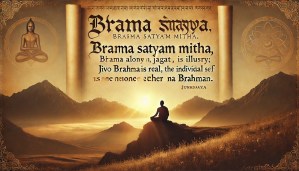
“Brahma satyam jagat mithya, jivo brahmaiva na aparah.”
“Brahman alone is real, the world is illusory; the individual self is none other than Brahman.”
Join Our Classes:
The Upanishads are more than just ancient texts—they are timeless guides to living with clarity, balance, and inner peace. Our classes make their profound wisdom easy to understand and apply in everyday life. Join us to explore these teachings and discover a new way of seeing yourself and the world!