Bhahmananda Vallli – Anuvaka 8 & 9
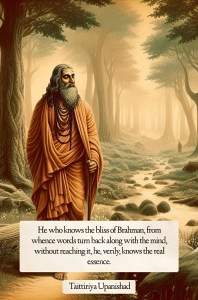
Anuvakas 8 and 9 of the Brahmananda Valli present the peak of Vedantic realization, declaring the Self as limitless bliss and pure consciousness. Anuvaka 8 teaches that true fearlessness arises when one realizes Brahman as the inner Self, transcending all duality. This Brahman, being beyond thought and speech, is the very source of joy that even gods seek. Anuvaka 9 affirms the oneness of the Self in man and the cosmos, culminating in the mahavakya “Prajñānam Brahma”—Consciousness is Brahman. Sankaracharya emphasizes that this consciousness is not mental or sensory, but the very essence of reality. Through this direct knowledge, the seeker attains unity with all existence and ultimate liberation. For More Information Click Here

Sankaracharya’s Bhaṣya on Anuvakas 8 & 9: The Self as Infinite Bliss and Pure Consciousness
Anuvaka 8: Ānanda-svarūpa and Fearlessness
Main mantra:
ānandaṁ brahmaṇo vidvān na bibheti kutascana
“The knower of Brahman as bliss does not fear anything at all.”
Sankara’s insights:
-
Bliss is not an attribute of Brahman, but its very nature (ānanda-svarūpam).
It is not joy derived from external conditions, but the intrinsic fullness of being. -
Fearlessness is the mark of Self-realization.
Sankara explains that fear arises from duality (from seeing oneself as separate from the world or Brahman). When duality ends through knowledge, so does fear. -
Mind and speech cannot reach Brahman (yato vāco nivartante…).
Sankara clarifies that Brahman is not an object that can be grasped. It is the subject, the witness, the sākṣin—beyond conceptualization. -
Even gods desire this knowledge, which shows that Brahman-realization is the highest attainment.
Anuvaka 9: Unity and the Mahavakya “Prajñānam Brahma”
Main mantra:
sa yaścāyam puruṣe, yaścāsāvāditye, sa ekaḥ; ya enaṁ veda, asya sarvam bhavati; prajñānam brahma
“He who is in man and he who is in the sun, is one. He who knows this, becomes all. Consciousness is Brahman.”
Sankara’s insights:
-
There is only one Self, appearing as both the antarātman (in the individual) and the āditya (cosmic). The distinction is only apparent, due to upadhis (limiting adjuncts like body and mind).
-
“Asya sarvam bhavati” – the knower becomes one with all.
Sankara explains this not as physical possession but as identity with all existence due to the removal of ignorance. -
Mahavakya: “Prajñānam Brahma”
Sankara interprets prajñānam as the self-revealing, uninterrupted consciousness that illumines all experience. This is not limited by the mind or intellect—it is the very Brahman. -
Liberation (moksa) comes only through this knowledge—not through rituals or external actions.

Summary of Sankara‘s Teaching in These Two Anuvakas:
-
Brahman is bliss (ananda) and consciousness (prajñāna), and this is none other than the true Self.
-
Fearlessness, fullness, and unity with all beings arise when one realizes this truth.
-
This non-dual knowledge is immediate (aparokṣa) and liberates one from all bondage.
Bhrigu Valli – Anuvaka 1 to 9
The Bhrigu Valli presents a profound journey of self-inquiry, where Bhrigu progresses from gross to subtle realizations—food, prana, mind, intellect, and finally bliss—as Brahman. Guided by his father Varuna, he doesn’t stop at each stage but continues inward, reflecting the Upaniṣadic method of viveka (discrimination). Adi Sankaracharya emphasizes that true knowledge is not conceptual but direct realization through tapas and reflection. Bliss (ananda) is revealed as the ultimate nature of Brahman and the Self. The knower of this truth becomes fearless, fulfilled, and liberated. Thus, the Valli encapsulates the path from seeking to knowing, and knowing to being. For More Information Click Here
Bhrigu Valli: The Experiential Ascent to Brahman – With Sankara’s Insights
Anuvaka 1: Beginning the Inquiry
Theme: Initiation of the inquiry into Brahman (brahma-vijñāna) by Bhrigu.
Summary:
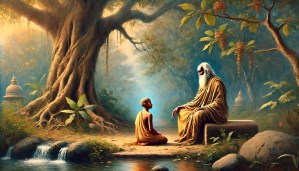
Bhrigu approaches his father Varuna and requests to be taught about Brahman. Varuna instructs him to meditate on Brahman as that from which beings are born, by which they live, and into which they dissolve. This verse sets the framework for experiential learning through reflection and tapas (austerity/discipline).
Sankara’s Insight:
Sankara emphasizes that true knowledge of Brahman is not theoretical but must be realized through inquiry and meditation. This is adhikāra-vākya—qualifying Bhrigu for the pursuit of knowledge.
Anuvaka 2: Food (Anna) as Brahman
Theme: First level of realization—identifying Brahman with food (anna).
Summary:
Bhrigu meditates and concludes that food is Brahman, as it sustains life. But this is only a partial understanding.
Sankara’s Insight:
This represents a gross (sthūla) conception of Brahman. Sankara notes that although food is essential for life, it cannot be the ultimate reality since it is perishable and dependent.
Anuvaka 3: Vital Force (Prana) as Brahman
Theme: Deeper realization—Brahman as prana (vital energy).
Summary:
Upon deeper meditation, Bhrigu understands Brahman as prana, the sustaining life-force.
Sankara’s Insight:
Prana is subtler than food but still limited and not self-revealing. It too depends on something deeper—thus, inquiry must continue.

Anuvaka 4: Mind (Manas) as Brahman
Theme: Brahman as mind—that which wills, desires, and thinks.
Summary:
Bhrigu realizes mind as Brahman, since it directs life. But again, he is not fully satisfied.
Sankara’s Insight:
Mind is a subtle instrument but still associated with duality and change, and hence not the supreme reality.
Anuvaka 5: Intellect (Vijñāna) as Brahman
Theme: Realization of Brahman as discriminative knowledge.
Summary:
Bhrigu now considers the intellect (vijñāna) as Brahman, the faculty of discernment and understanding.
Sankara’s Insight:
Even vijñāna, though subtler, remains dependent on the Self. It helps in knowing Brahman, but is not Brahman itself.
Anuvaka 6: Bliss (Ananda) as Brahman
Theme: Highest realization—Brahman is ānanda (bliss).
Summary:
Finally, Bhrigu attains the realization that bliss is Brahman. This is the true Self, unchanging, ever-full, and independent.
Sankara’s Insight:
This is the correct conclusion, aligning with ānandam brahma iti vyajānāt. Sankara affirms that the Self is of the nature of pure bliss, the substratum of all experiences.

Anuvaka 7: Praise of Bliss and the Wise
Theme: Description of the wise one who knows Brahman as bliss.
Summary:
Such a knower, established in bliss, becomes calm, controlled, detached, and attains freedom and fulfillment.
Sankara’s Insight:
The characteristics described here are signs of jīvanmukti (liberation while living). Bliss is not emotional joy but unconditioned fullness.
Anuvaka 8: Inner Contentment and Behavior of the Knower
Theme: The life and behavior of one established in Brahman.
Summary:
The one who knows bliss as Brahman becomes compassionate, generous, and devoted to dharma, living in tune with all beings.
Sankara’s Insight:
Knowledge naturally expresses itself in conduct—the jñānī becomes a giver and a blessing to society.
Anuvaka 9: Fruits of Knowledge and Conclusion
Theme: Results of realization and glorification of Brahman-knowledge.
Summary:
Whoever knows this becomes established in Brahman, attains fearlessness, and fulfills life’s highest purpose. The Upaniṣad ends with blessings and peace.
Sankara’s Insight:
True knowledge destroys all ignorance and fear, and brings about supreme liberation. This final section affirms the fruit of Self-realization.

Sankaracharya’s Insights on Brahmananda Valli Anuvakas 8 & 9 and Bhrigu Valli Anuvakas 1 to 9
Adi Sankaracharya, in his commentary on Brahmananda Valli Anuvakas 8 & 9 and Bhrigu Valli Anuvakas 1 to 9, affirms that Brahman is pure consciousness and limitless bliss (ānanda-svarūpa). In Brahmananda Valli, he explains that realizing the Self as Brahman dispels all fear, for fear arises only when there is duality; in non-dual awareness, there is nothing apart from oneself. The mahavakya “prajñānam brahma” reveals that Brahman is not inert, but self-luminous consciousness, ever present and all-pervading. In Bhrigu Valli, Sankaracharya guides us through Bhrigu’s stepwise realization—from food to prana, mind, intellect, and finally to bliss—emphasizing that only bliss is the final, independent, and real essence. Each earlier stage is helpful but partial, and it is only ananda, the unchanging substratum, that is the true Brahman. Ultimately, Sankara teaches that liberation comes not through action but through direct knowledge of the Self as non-dual, infinite, and blissful. For More Information Click Here

Conclusion: The Culmination of Self-Knowledge in Brahmananda and Bhrigu Vallis
Anuvakas 8 and 9 of the Brahmananda Valli and the full Bhrigu Valli together represent the zenith of Vedantic insight as unfolded in the Taittiriya Upaniṣad. Anuvaka 8 affirms that Brahman is bliss (ananda) and that fear vanishes upon realizing this truth. Anuvaka 9 crowns this with the mahavakya “Prajñānam Brahma”, declaring pure consciousness as the essence of all. The Bhrigu Valli, in parallel, portrays the inner ascent of the seeker, from food to prana, to mind, to intellect, and ultimately to bliss as Brahman, verified by direct experience. Adi Sankaracharya clarifies that this journey is not metaphorical but a transformative realization of one’s true nature. The liberated one becomes fearless, full, and one with all beings, embodying both wisdom and compassion. Thus, these sections together offer a complete Vedantic vision—from inquiry to realization, from individuality to unity.
Join Our Classes:
The Upanishads are more than just ancient texts—they are timeless guides to living with clarity, balance, and inner peace. Our classes make their profound wisdom easy to understand and apply in everyday life. Join us to explore these teachings and discover a new way of seeing yourself and the world!