Introduction
Volume 28 of Vichāra Sāgara continues the exposition in Chapter 6, targeting seekers whose intellect is still active and questioning (the “kaniṣṭha-adhikārī” stage). According to the index of the text, this volume likely covers the later portion of the enquiry into the three questions (Who am I? Who is the creator? What is the means of liberation?), and begins motion towards Chapter 7 (the stage of jīvanmukti and videhamukti, the fully realised state). The document hosted at VedantaStudents gives this volume as part of the sequence following Volume 27. In essence, Volume 28 is for the seeker who has tasted enquiry and is now being guided through the subtler implications of non-dual realisation, integration, and abiding as the Self beyond mere intellectual understanding. Click Here To Access more other text.

Benefits of Studying This Volume
By studying Volume 28, the aspirant stands to gain several key benefits:
- It helps anchor the enquiry into lived realisation — beyond merely asking “Who am I?” to abiding as “I am that”.
- It shows how the insights gained (about many-jīvas, subtle body, superimposition, etc.) now function in daily life and in the shift toward the effortless abiding as the Self.
- It supports the transition from seeking (the aspirant stage) to established realisation (the realised being) by clarifying how the Self acts (or does not act) in the world of forms.
- It deepens clarity by addressing the remaining knots of identification, subtle assumptions, and latent vasanas which still pull the mind away from pure awareness.
- It offers stability and completeness: as you integrate the non-dual viewpoint, Volume 28 reinforces that the goal is not remote but here and now — you already are that. Click view PDF.

Sanskrit Verse
‘जगत् कर्ता कः’ इति द्वितीयप्रश्नोऽयमनीमुत्तरः उच्यते।
व्यापकचैतन्यमाश्रित्य तदेव विषयीकृत्य मायेव सदसद्विलक्षणातद्वृत्तिशक्तिरूपाज्ञानमित्युच्यते।
तस्मादज्ञानाज्जगत् उत्पत्तिर्भवति।
Transliteration
“Jagat kartā kaḥ?” iti dvitīya praśno’yam anīmuttraḥ ucyate.
Vyāpaka-caitanyam āśritya, tadeva viṣayī-kṛtya, māyā eva sat-asat-vilakṣaṇa-tad-vṛtti-śakti-rūpa-ajñānam iti ucyate.
Tasmād ajñānāt jagat utpattiḥ bhavati.”
Meaning (Simple Translation)
“The second question, ‘Who is the creator (karta) of the world (jagat)?’, is now being answered.
Relying upon all-pervasive Consciousness (vyāpaka-caitanya) and making It the substratum and the basis of experience, that very Consciousness — when associated with māyā, which is neither real (sat) nor unreal (asat), but different from both and endowed with the power of projection (śakti) — is said to be ajñāna (ignorance).
From this ajñāna, the creation (jagat) arises.”
Explanation
This verse gives the Advaita Vedānta answer to the question, “Who created the world?”
-
The Question:
Every seeker eventually asks, “If Brahman is pure consciousness, unchanging and actionless, then who made this world?” -
The Teaching:
-
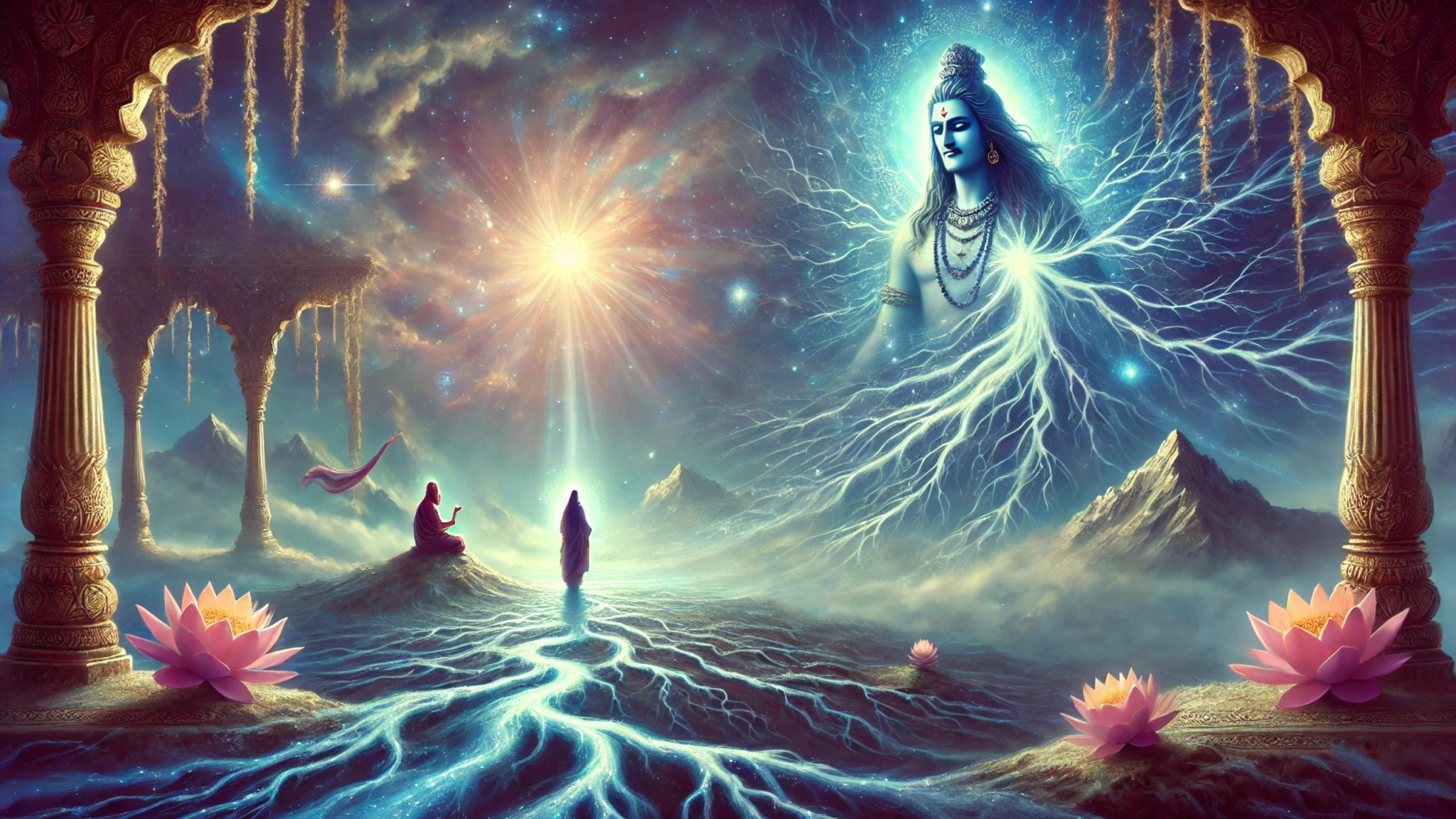
The ultimate reality, Brahman, is pure Consciousness (vyāpaka-caitanya) — all-pervading, without doership or change.
-
But when that Consciousness appears associated with Māyā — the power of illusion — it seems to become the creator (Īśvara).
-
Māyā is neither real (sat) nor unreal (asat); it is indefinable (anirvacanīya) and possesses the śakti (power) of projection.
-
When this power operates in Consciousness, the appearance of creation (the universe) arises — just as dream images arise in the light of the dreamer’s mind.
-
-
The Key Insight:
-
The world is not created by Brahman directly, because Brahman is changeless.
-
Nor is it created by something outside Brahman, because nothing exists outside It.
-
Therefore, it arises through Māyā, a mysterious power rooted in Brahman — like the snake appearing on the rope.
-
-
In summary:
The Creator (Karta) is Consciousness reflected in Māyā, called Īśvara.
From the standpoint of truth, no creation has ever truly occurred; only ajñāna (ignorance) gives rise to the appearance of a world.

Spiritual Significance
- This verse dissolves the confusion about who creates.
- It shows that creation is an appearance, not a real event.
- The real “cause” is ajñāna (ignorance) — the inability to see Brahman as One.
- Once ignorance is destroyed by knowledge (jñāna), the sense of world and doer vanishes, revealing only pure Consciousness.
How to Study
To study Volume 28 effectively, consider the following approach:
-
With a guide or teacher: Since this volume likely deals with very refined aspects of non-dual realisation and integration, it’s helpful to work under someone experienced in Advaita or non-dual teaching.
-
Sequential reading: Begin with the first topic of the volume, proceed steadily rather than skipping ahead, so you maintain the momentum of the enquiry and the context built in previous volumes.
-
Reflective enquiry: After each section/topic ask yourself questions such as:
• “What change in me is being pointed to here?”
• “Am I still seeking, or abiding as?”
• “What subtle assumption remains — that the Self must do something, or that I am the actor?” -
Meditation & assimilation: After reading, sit quietly and rest as the witness. Notice how the teaching resonates in your lived experience. Allow the mind to soften and abide in the background. Click view PDF.
-
Journalling: Write down:
• Moments when you notice the shift from doing to simply being.
• Patterns of self-identification still active.
• How your sense of daily life (actions, relationships, thoughts) changes as you reflect on the text. -
Integration into life: Use the insights in everyday life — when interacting, observe: “Am I the actor, or is consciousness simply expressing?” When resting, notice: “Who is aware of the body, mind, objects?” Let the teachings move from book-knowledge to living reality. Click view PDF.

Why Study
Reasons why one should study Volume 28 include:
- Because after intellectual enquiry, the next vital stage is integration into being — without this, the teaching remains academic and may fail to transform. Volume 28 supports that transition.
- Because many seekers plateau: they understand “I am the Self” intellectually but still live as “I am the person”. This volume offers the deeper themes and tools to move beyond that plateau.
- Because it prepares you for the final chapter (Chapter 7) of the text — the state of jīvanmukti and videhamukti — by clarifying what it means to abide as the Self in the midst of form, and what remains when form ceases. Click view PDF.
- Because the teachings here are subtle and often misunderstood; studying them helps prevent mistakes, misconceptions, and dissolves residual duality.
- Because the goal of the path is not far off — you already are that which you seek — and this volume helps you live from that recognition rather than just think about it.

How Many Times to Study
Here’s a suggested rhythm for studying Volume 28:
- First pass: Read the volume through once to get a complete overview — grasp the themes, topics, and major pointers.
- Second pass: Read more slowly, annotate major statements, reflect after each topic, pause and absorb.
- Third pass (and more): For each section, integrate reading, meditation, journaling and daily life observation — allow the teaching to settle.
- Periodic revisiting: As your enquiry deepens and your insight grows, revisit the volume every 6-12 months (or more) because new layers of meaning will emerge.
- As a lifetime companion: Recognise that this text is not just for once-off reading but becomes a living tool: when you notice stuckness, revisit relevant sections for refreshment and deepening. Click view PDF.
Conclusion
Volume 28 of Vichāra Sāgara is a pivotal text for the sincere seeker. It invites you not just to know, but to be; not just to enquire, but to abide. When studied not merely as theory but as a living instrument of transformation, this volume helps shift the aspirant from “I am seeking” to “I am that which is sought”. It holds the key to living the non-dual reality in all states of experience, and prepares you for the final unfolding in Chapter 7. Whether you are fairly new to non-dual enquiry or you’ve been on the path for some time, this volume supports the movement from transient identification to timeless awareness. In the living of that shift lies freedom.
Join Our Classes:
The Vichara Sagara are more than just ancient texts—they are timeless guides to living with clarity, balance, and inner peace. Our classes make their profound wisdom easy to understand and apply in everyday life. Join us to explore these teachings and discover a new way of seeing yourself and the world!