Illusion, Knowledge, and the Realization of the Self
Verses 29 to 32 of the Mandukya Karika by Gaudapadacharya delve into the profound nature of the Self and the illusory appearance of the world. These karikas emphasize that the ultimate reality, Brahman, is motionless, unchanging, and beyond conceptual knowledge. The waking, dream, and deep sleep states are shown to be mere projections caused by ignorance (avidya), much like dreams. True wisdom lies in recognizing the ephemeral nature of these states and realizing the underlying Self, which is ever-present and non-dual. The wise distinguish between the Self and the non-Self, cutting through the illusion of samsara. These verses guide seekers toward liberation through self-inquiry and knowledge. For More Information Click Here

Mandukya Karika Verses 29–32: Illusory Nature of the World and Realization of the Self
Karika 29
निःस्पन्दं ब्रह्म परमार्थं उच्यते।
ज्ञानं यत्र प्रविलीयते च ।
अविद्यया कल्पितमेतदात्मनः
स्वप्नो यथा सत्त्वमिदं निराकृतम् ॥ २९ ॥
Transliteration:
Niḥspandaṁ brahma paramārthaṁ ucyate,
jñānaṁ yatra pravilīyate ca |
avidyayā kalpitam etad ātmanaḥ
svapno yathā sattvam idaṁ nirākṛtam ||
Meaning:
The motionless (changeless) Brahman is the ultimate reality, where even knowledge dissolves. This world is projected by ignorance (avidya) upon the Self, just like a dream. Upon realization, its objective reality is negated. For More Information Click Here
Karika 30
विचार्यते यः कथं आत्मभावे,
निवर्तते तस्य तदात्मदृष्टम्।
ज्ञानस्य यस्मिन्नवशेषभावः,
स आत्मदृग्योऽवगमः स आत्मा ॥ ३० ॥
Transliteration:
Vicāryate yaḥ kathaṁ ātmabhāve,
nivartate tasya tadātmadṛṣṭam |
jñānasya yasmin avaśeṣabhāvaḥ,
sa ātmadṛg yo’vagamaḥ sa ātmā ||
Meaning:
That which, upon inquiry, merges into the Self, and in which no objective knowledge remains, is the true Self, the seer of the Self—this direct experience is Ātman.
Karika 31
स्वप्नो यथा दृष्टमतो निदर्शने,
कल्पं ह्यवस्थं त्रिविधान् नृलोक्यः।
मायासृजं ह्यात्ममयं च सर्वं,
एकात्मता मिथ्यतया निगद्यते ॥ ३१ ॥
Transliteration:
Svapno yathā dṛṣṭam ato nidarśane,
kalpaṁ hy avasthāṁ tridhidhān nṛlokyaḥ |
māyāsṛjaṁ hy ātmamayaṁ ca sarvaṁ,
ekātmatā mithyatayā nigadyate ||
Meaning:
Just as seen in dreams, all three states (waking, dreaming, deep sleep) are only appearances created by Māyā and the mind. Their oneness with the Self is apparent, but this unity is not ultimately real—it’s spoken of from the empirical standpoint.
Karika 32
आत्मा ह्यनात्मा प्रविभक्ततत्त्वो,
मायागुणेनैव तु कालपीतः।
संसारमेतं प्रविभाव्य विद्याः,
ते तत्त्वबुद्ध्या विनिवर्तयन्ति ॥ ३२ ॥
Transliteration:
Ātmā hy anātmā pravibhakta-tattvo,
māyā-guṇenaiva tu kālapītaḥ |
saṁsāram etaṁ pravibhāvya vidyāḥ,
te tattva-buddhyā vinivartayanti ||
Meaning:
Though the Ātman is distinct from the non-Self, it appears bound by Māyā and time. The wise, through discrimination, perceive this distinction and dissolve samsāra through true knowledge.
Adi Shankaracharya’s Advaitic Perspective on Mandukya Karika Verses 29–32
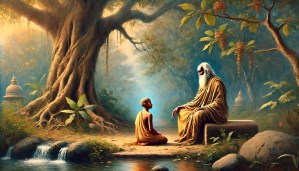
Adi Shankaracharya’s insights on Mandukya Karika verses 29 to 32 emphasize the core principles of Advaita Vedanta—non-duality, the unreality of the world, and the supreme reality of the Self. In verse 29, Shankara explains that Brahman is motionless and changeless, and that even knowledge dissolves in it, as knowledge implies duality, which has no place in the non-dual Self. The world, like a dream, is a projection born of ignorance and vanishes upon true realization. In verse 30, he points out that when all objects of experience are negated through inquiry, what remains is the pure, witnessing consciousness—the true Self. Verse 31 continues this idea by asserting that the waking, dream, and deep sleep states are all illusory, created by Māyā, and have no independent reality apart from the Self. Finally, in verse 32, Shankara affirms that the wise, through discrimination between the Self and non-Self, overcome the illusion of samsara. Though the Self appears bound due to Māyā and time, it is eternally free, and realization of this truth through knowledge alone leads to liberation. For More Information Click Here
Conclusion
In conclusion, Adi Shankaracharya’s insights on Mandukya Karika 29–32 reinforce the core Advaitic vision that the world is a projection of ignorance, much like a dream. The ultimate reality, Brahman, is beyond all activity, duality, and even knowledge as we commonly understand it. True liberation lies in realizing the Self as distinct from the transient states of waking, dreaming, and deep sleep. Through discrimination and self-inquiry, the wise dissolve the illusion of samsara. These verses serve as a powerful guide for seekers to transcend appearances and abide in non-dual awareness. Shankara’s commentary helps illuminate this subtle and transformative truth.
Join Our Classes:
The Upanishads are more than just ancient texts—they are timeless guides to living with clarity, balance, and inner peace. Our classes make their profound wisdom easy to understand and apply in everyday life. Join us to explore these teachings and discover a new way of seeing yourself and the world!