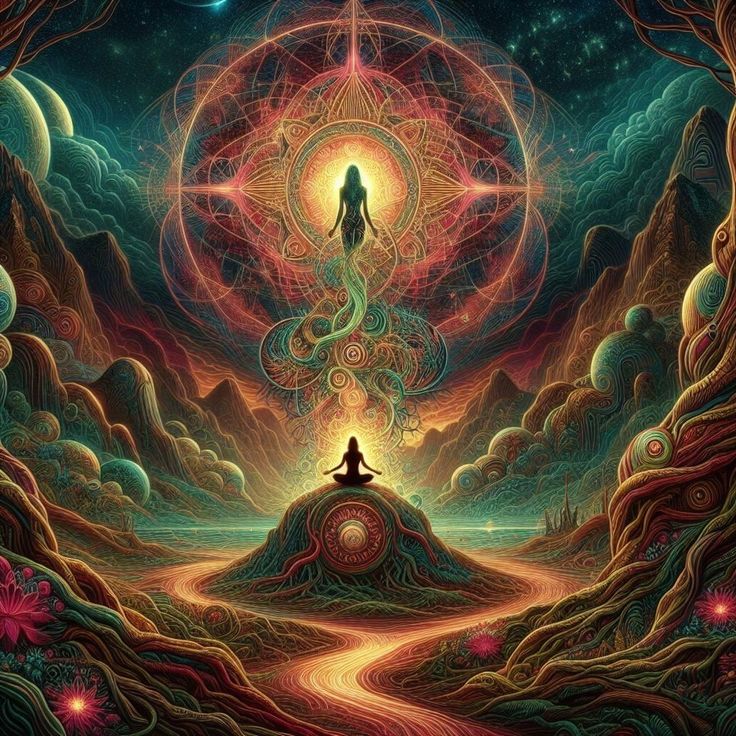
The Final Truth: Consciousness as the Ultimate Goal
The Upanishad affirms that all states of consciousness—waking, dreaming, and deep sleep—depend on the imperishable Brahman, just like spokes depend on the wheel’s hub. This Brahman is none other than the Self (Ātman), which is pure consciousness (Chaitanya). It is immortal, unchanging, and the foundation of all existence. Every world, being, and experience rests upon this eternal reality. The text declares that nothing exists beyond it. This Self is the ultimate goal, the final destination of spiritual pursuit. For More Information Click Here
Prashna Upanishad – Chapter 6
Verse 2
“On that imperishable Brahman all these states are established like spokes on the hub of a wheel.”
Explanation:
This part reinforces the metaphor. The waking, dream, and deep sleep states are not independent—they are upheld by the unchanging Brahman. Just as the hub holds the wheel together, Brahman supports all our states of consciousness. Without it, these states could not arise or be known.
Verse 3
“That Self is consciousness (Chaitanya), it is Brahman, it is called the immortal. On it all the worlds rest. None goes beyond it. This is the end of the journey. This is the supreme goal.”
Explanation:
Here, the Self is equated with Brahman—the eternal, all-knowing reality. It is consciousness itself, not merely something that has consciousness. Everything—all worlds, all experiences—rests upon it. No one can go beyond it, as it is the final truth, the goal of all spiritual striving, and the true identity of the seeker. Realizing this Self is liberation. For More Information Click Here
The Self as Brahman: Shankara’s Ultimate Insight
Shankaracharya emphasizes that the Ātman (Self) is not just a part of human experience—it is the very basis of all experiences and states of consciousness. He explains that the waking, dreaming, and deep sleep states appear and disappear, but the Self remains unchanged, like the hub of a wheel that supports the changing spokes.
In verse 3, when the Upanishad says the Self is Chaitanya (pure consciousness) and Brahman, Shankaracharya affirms the identity of the individual Self (Jivātman) and the Supreme Self (Paramātman). This Self is immortal, without beginning or end, and it is not known through action or ritual, but through direct knowledge (jñāna). For More Information Click Here
By declaring that nothing exists beyond this Self, Shankara teaches that the ultimate purpose of life is to know this non-dual reality. One who realizes it becomes free from ignorance, bondage, and rebirth. This is moksha (liberation)—not a place to reach, but the truth to be recognized within oneself.
Conclusion
These verses reveal the heart of Vedantic wisdom—that the individual Self is not different from the universal Brahman. The ever-present awareness within us is the support of the cosmos, not limited by body, mind, or time. Liberation (moksha) is not reaching somewhere new, but realizing the ever-present truth within. One who knows this Self crosses beyond death and duality. It is the culmination of all inquiry, the highest goal of life. The seeker becomes one with the infinite, free, fearless, and full.
Join Our Classes:
The Upanishads are more than just ancient texts—they are timeless guides to living with clarity, balance, and inner peace. Our classes make their profound wisdom easy to understand and apply in everyday life. Join us to explore these teachings and discover a new way of seeing yourself and the world!