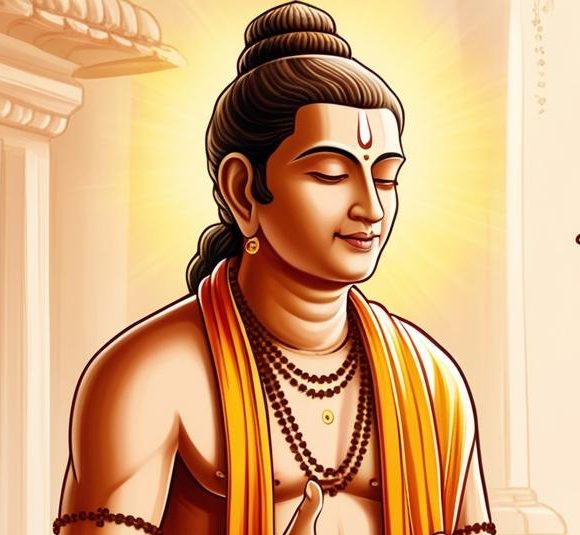
Bhagavad Gita Bhashyam – Volume 03
Deep Q&A Explanation
1. What is Bhagavad Gita Bhashyam – Volume 03?
Answer:
Bhagavad Gita Bhashyam – Volume 03 is a continuation of the Advaita Vedanta commentary (Bhāṣya) on the Bhagavad Gita, focusing on Chapter 3 (Karma-Yoga) of the Gita.
Just as Volume 01 established the problem of ignorance (Avidya) and the nature of the Self, Volume 03 explains why action (karma) is unavoidable and how it can be transformed into a spiritual discipline that supports liberation.
This is not a simple explanation of “work” or “duty,” but a philosophical integration of ethics, psychology, and Vedantic wisdom. Click Here To Access more other text.

2. Why does Volume 03 focus on Karma-Yoga?
Answer:
Because even after knowing one’s true nature, people still act in the world.
Shankara’s commentary clarifies:
👉 Action does not disappear just because one knows the Self.
👉 The question becomes: How should an enlightened (or aspiring) person act?
Volume 03 addresses the apparent contradiction between:
-
Knowledge as the means of liberation
and -
Action as a necessary aspect of life
Shankara teaches that action is not a barrier but a preparatory discipline that purifies the mind for Self-realization. Click Here To Access.
3. What fundamental problem does Volume 03 tackle?
Answer:
The volume tackles the problem of bondage created by action when it is done with desire and ego.
Shankara explains that:
➡ action arises as long as the mind is identified with the body and ego
➡ attachment to results (kāma) binds the person
➡ ignorance makes one think “I am the doer.”
So the problem isn’t action itself — it is attachment to the consequences and the sense of doership. Click Here To Access.
4. What is the role of action according to Volume 03?
Answer:
Shankara clarifies:
✔ Action is unavoidable
✔ Action rooted in ego and craving binds
✔ Action offered without attachment purifies the mind
✔ A purified mind becomes fit for Self-knowledge
In other words:
Action doesn’t give liberation, but it prepares the seeker for liberation through knowledge.
This is a radical redefinition of traditional ideas about work — instead of rejecting action, one transforms its meaning. Click Here To Access.

5. Why is inaction not possible?
Answer:
Shankara points out:
-
Even maintaining the body is action.
-
Thinking, intention, and perception all involve movement of the mind.
-
Declaring oneself “inactive” while desiring results mentally is hypocrisy.
This shows that true inactivity (naiṣkarmya) is not about not moving, but about not being psychologically driven by desires. Click Here To Access.
6. What is the source of bondage in action?
Answer:
Bondage arises from:
✔ attachment to results (kāmya-karma)
✔ sense of doership (kartṛtva)
✔ identification with the body-mind
These cause anxiety, craving, fear of loss, and repeated cycles of action and reaction.
Shankara explains that ignorance is even deeper than action — because action becomes binding only when the mind misidentifies “I” with the doer. Click Here To Access.
7. How does Volume 03 redefine Karma-Yoga?
Answer:
Karma-Yoga, in this context, means:
👉 performing one’s duty without attachment to outcomes
👉 offering the results to the Divine (or to a principle higher than ego)
👉 acting with awareness, not craving
This frees the mind from:
-
obsessive desire
-
emotional reactivity
-
fear of failure or success
So Karma-Yoga becomes:
not doing without action,
but doing without being driven by desire. Click Here To Access.
8. How does Volume 03 relate action to liberation?
Answer:
Shankara makes it clear:
✔ Action alone cannot liberate.
✔ Knowledge alone liberates.
✔ But action, rightly understood and performed, removes obstacles to knowledge.
That means:
Action purifies the psychological ground
Knowledge removes ignorance itself
Purified mind receives truth directly
This sequence is central to Vedantic psychology.
9. What is the real goal of studying Volume 03?
Answer:
Not merely to learn about Karma-Yoga intellectually, but to:
✔ see how desires shape behaviour
✔ notice how attachment creates suffering
✔ learn how to act without craving
✔ build a psyche receptive to Self-knowledge
✔ dissolve the sense of doer instead of stopping action
This is inner transformation — not merely reading a philosophy. Click Here To Access.

10. What practical change does Volume 03 lead to?
Answer:
Not external renunciation, but:
✔ reduced guilt about action
✔ less fear of results
✔ greater emotional clarity
✔ increased inner freedom
✔ responsible engagement in life
This transforms:
-
compulsive behaviour
-
anxious attachment
-
ego-driven decision making
into:
✔ clarity of purpose
✔ serenity in action
✔ inner stability Click Here To Access.
Summary: Core Message of Volume 03
Action is inevitable, but attachment is optional.
Karma-Yoga purifies the mind, and that purified mind becomes fit for Self-knowledge and liberation.
This volume harmonizes Vedanta with everyday life —
not by rejecting action, but by redeeming it.
One Deep Takeaway
Action is the soil — attitude is the seed — and Self-knowledge is the fruit.
When action is done without ego and craving, the soil becomes fertile for wisdom.