Introduction
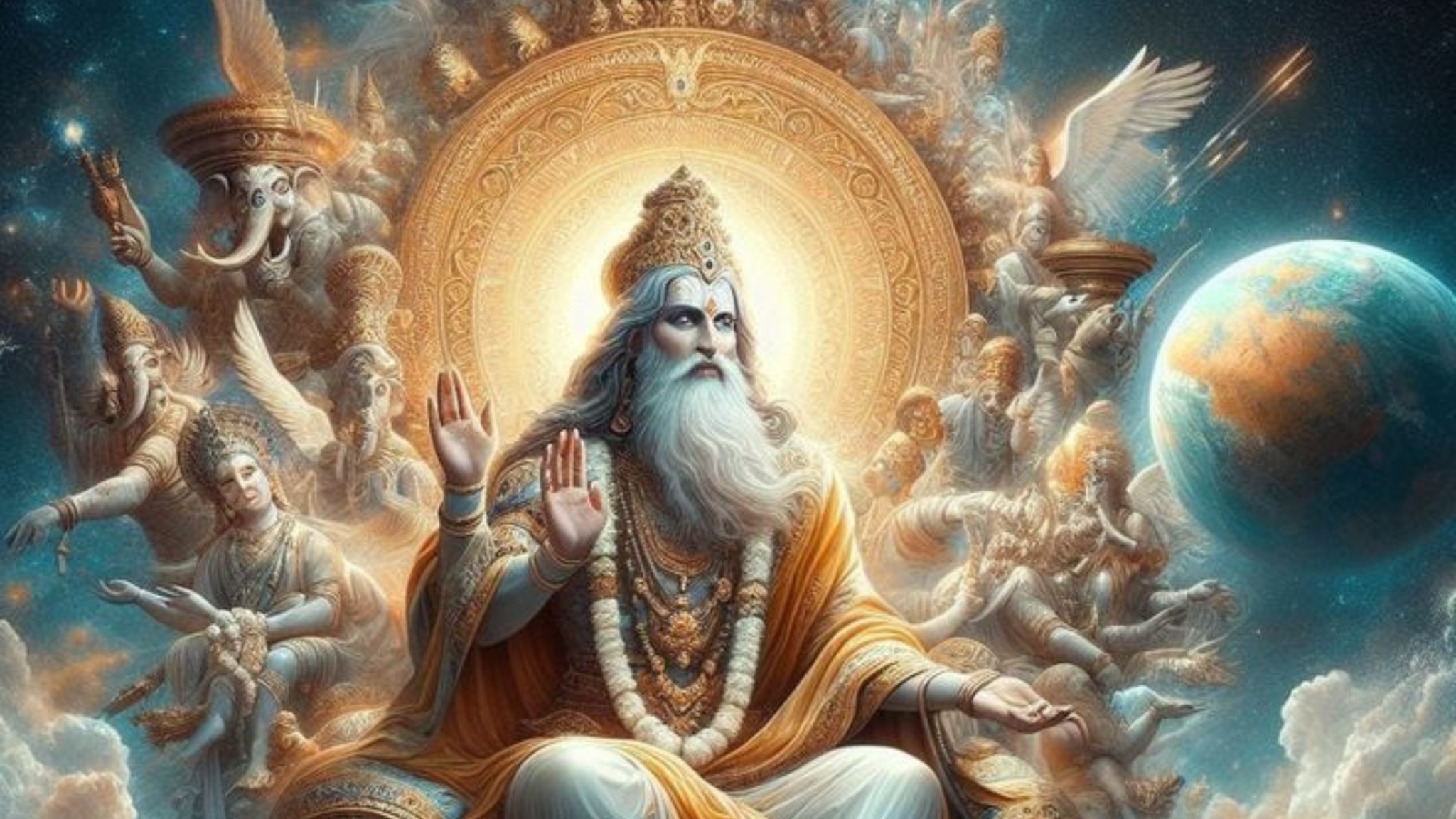
Chapter 11 of the Bhagavad Gītā is called Viśvarūpa Darśana Yoga — The Yoga of the Vision of the Universal Form. In this dramatic and deeply spiritual chapter, Arjuna requests Krishna to show His cosmic, universal form. Krishna grants him divine vision (divya-chakṣhu) and reveals a form that is simultaneously infinite, majestic, and terrifying. Through this vision, Arjuna realizes Krishna’s transcendental reality: Krishna is not just a friend or charioteer, but the source and sustainer of the entire universe. This chapter marks a turning point in Arjuna’s understanding — he moves from seeing Krishna in a limited, personal sense to perceiving the Divine as all-encompassing. Click Here To Access more other text.

Benefits of Studying Chapter 11
-
Deepens Devotional Reverence: Witnessing the cosmic form fosters awe, wonder, and total surrender (bhakti).
-
Reveals Divine Omnipresence: One comes to understand that God pervades everything — all beings, all forms, and all times.
-
Clarifies the Nature of Reality: This chapter gives a philosophical insight into the unity of the manifest world and the unmanifest divine.
-
Encourages Surrender over Fear: Arjuna’s fear at seeing Krishna’s terrifying form and his eventual devotion teaches about surrendering to the Divine will.
-
Highlights Grace: The vision itself is not possible without Krishna’s grace (He gives Arjuna “divine eyes”).
-
Guides for Action: By seeing the inevitability of cosmic law (time, destruction), Arjuna is reminded to act as Krishna’s instrument, not out of ego. Click view PDF.
Meaning & Translation: Verses 1–10 (Detailed)
Here is a detailed meaning + explanation of verses 1–10 of Chapter 11, based on Vedanta Students’ versewise PDF Vedanta Students, supplemented by traditional understanding:
Verse 1:
-
-
Sanskrit / Key Meaning: Arjuna says that by Krishna’s compassionate teaching of the highest truth (“the secret of the Self”), his old confusion has been dispelled.
-
Interpretation: Arjuna recognizes that Krishna’s previous instructions (in earlier chapters) have already cleared many of his doubts. This is not just intellectual knowledge, but knowledge that touches his heart and removes his fear.
-
Spiritual implication: True spiritual teaching (if given out of compassion) can dissolve deep delusion; receiving it humbly is key. Click view PDF.
-

Verse 2:
-
-
Meaning: Arjuna says he has heard in detail from Krishna about the origin and dissolution of beings, and Krishna’s inexhaustible glory.
-
Interpretation: He refers to Krishna’s earlier teachings (on creation, the soul, the world, and time) and acknowledges that Krishna’s greatness is boundless — not limited to what Arjuna already knows.
-
Spiritual implication: Spiritual knowledge is an ongoing journey; even after hearing many teachings, a real seeker may long for deeper vision. Click view PDF.
-
Verse 3:
-
-
Meaning: Arjuna asks: “As You have described Yourself, O Supreme Lord, so it is indeed; but still, I wish to see Your Iśvara‑form, O Supreme Purusha.”
-
Interpretation: Though Arjuna accepts Krishna’s description, his devotion and curiosity make him long for a direct vision of Krishna’s divine form.
-
Spiritual implication: Intellectual acceptance is good, but the soul often yearns for an experiential realization of the Divine. Click view PDF.
-
Verse 4:
-
-
Meaning: Arjuna continues: “If, O Lord, You think me able to behold it, then, O Master of Yogis, reveal to me Your immutable form.”
-
Interpretation: Arjuna humbly asks Krishna to show His eternal, cosmic form (not just a temporary or limited form), acknowledging that only if Krishna wills it can he see.
-
Spiritual implication: The vision of the universal form is not easy; it requires readiness, humility, and the Lord’s grace. Click view PDF.
-

Verse 5:
-
-
Meaning: Krishna replies: “Behold, O Partha, My forms by the hundreds and thousands — divine, of many colors and many shapes.”
-
Interpretation: Krishna is telling Arjuna that His manifestation is not limited to a few forms — He is infinite and manifests in countless ways.
-
Spiritual implication: God’s reality is multifaceted; part of spiritual vision is understanding the infinite richness of the divine. Click view PDF.
-
Verse 6:
-
-
Meaning: Krishna invites Arjuna to see the Ādityas (solar deities), Vasus, Rudras, the twin Āśvins, Maruts, and “many wonders never seen before.”
-
Interpretation: These are symbolic divine beings, representing cosmic functions and energies. Krishna is saying that all universal powers and deities exist in Him.
-
Spiritual implication: Recognizing these cosmic powers in God leads to an integrated vision — not compartmentalized spiritual or religious thinking. Click view PDF.
-
Verse 7:
-
-
Meaning: “Behold today, in this body of Mine, the entire moving and non-moving universe, whatever else you desire to see.”
-
Interpretation: Krishna reveals that the whole universe (everything that moves, like living beings, and everything that doesn’t, like mountains) is contained within His cosmic body.
-
Spiritual implication: The microcosm (our world) and the macrocosm (universe) are not separate — they exist in and as the Divine. Click view PDF.
-

Verse 8:
-
-
Meaning: But Krishna warns: “You cannot see Me with your present eyes; so I give you divine eyes (divya-cakṣhu) — behold My majestic yoga.”
-
Interpretation: Arjuna’s ordinary physical vision isn’t enough to perceive the universal form. Krishna grants a special vision to Arjuna to help him see the divine reality.
-
Spiritual implication: Divine vision is a gift — spiritual insight often requires a shift in consciousness, not just intellectual effort. Click view PDF.
-
Verse 9:
-
-
Meaning: Sanjaya (narrating to Dhṛtarāṣṭra) says: “Having said this, the supreme Lord showed Arjuna His glorious universal form, beyond all description.”
-
Interpretation: Sanjaya, with divine insight, describes how Krishna revealed Himself in a form that is infinite, wondrous, and indescribable.
-
Spiritual implication: The Divine transcends language and categories — true spiritual experiences often go beyond words. Click view PDF.
-
Verse 10:
-
-
-
Meaning: “Many mouths and eyes, many wondrous sights; many divine ornaments, many heavenly weapons.” (a description of Krishna’s universal form)
-
Interpretation: The vision Arjuna sees is multi-dimensional and majestic — countless faces, weapons, ornaments — symbolizing Krishna’s eternal power, creativity, and presence. Click view PDF.
-
Spiritual implication: The cosmic form is both beautiful and fearsome; the divine is creative, sustaining, and also capable of destruction. This vision helps the seeker appreciate the totality of divine reality.
-
-

How to Study This Chapter
-
Read Slowly & Reflectively
-
Go through the verses with the Vedanta Students’ PDF, reading one verse at a time.
-
After each verse, pause and think: What is being revealed here? What is Krishna teaching about His nature?
-
-
Use Meditation / Visualization
-
Try meditating on Krishna’s viśvarūpa: close your eyes and imagine a form that is infinite, with many faces, weapons, radiant brilliance — as described in these verses.
-
This helps internalize not just the “meaning,” but the experience of the cosmic form.
-
-
Journal / Write Reflections
-
Keep a notebook: after reading, write what surprised you, what you feel, and how this vision changes your understanding of God or the universe.
-
Note any fears, reverence, or insights that arise.
-
-
Discuss with Others
-
Join a study group (like Vedanta Students) and share your reflections. Other people’s insights can open up deeper meanings.
-
Ask questions: “Why does Arjuna ask for this vision?” “What does it mean that Krishna is both creation and destroyer?”
-
-
Integrate into Practice
-
Use verses or imagery from Chapter 11 in your daily spiritual practice (prayer, chanting, meditation).
-
Recall that divine vision can give strength when facing life’s challenges — seeing Krishna as the cosmic Lord reminds us that we are part of something larger. Click view PDF.
-
Why Study This Chapter
-
To Develop Awe & Humility: Seeing Krishna’s universal form shifts our perspective: we are not the center of everything, but part of a much greater reality.
-
To Strengthen Surrender: Arjuna’s surrender after seeing Krishna’s form is a model; we learn to let go of ego and trust in the divine plan.
-
To Understand Divine Power & Time: In this chapter, Krishna later reveals Himself as Time (kāla), which teaches about the inevitability of cosmic law and transformation.
-
To Nurture Devotion (Bhakti): This chapter emphasizes that to truly “see” God, devotion and grace matter more than ritual or study alone.
-
To Align with Dharma: By seeing the universal form, one understands that their actions are part of a larger cosmic order. We are instruments in a grander design. Click view PDF.

How Many Times to Study
-
First Pass: Read the entire chapter once (or at least verses 1–10) with the versewise notes.
-
Weekly Review: Revisit 2–3 verses per week for 4–6 weeks — reflect, meditate, journal.
-
Yearly Reflection: Once a year (or during a spiritual retreat), revisit and re-mediate on the entire chapter — as one’s maturity grows, new insights will come.
-
Daily Integration: Even if not re-reading, recall key images (like “many mouths, many eyes”) in daily life whenever you feel small or lost — it can help shift your perspective. Click view PDF.
Conclusion
Chapter 11 of the Gītā is one of the most profound and poetic revelations in spiritual literature. Through Arjuna’s request and Krishna’s cosmic vision, the chapter teaches that God is not limited to simple human-like forms — His reality is infinite, awe-inspiring, and beyond full comprehension. Studying this chapter helps the seeker cultivate humility, devotion, and surrender, while also offering a powerful philosophical insight into the nature of existence. When one internalizes Krishna’s universal form, one begins to see life itself as divine, and recognizes one’s role not just as an individual, but as part of an eternal, cosmic dance.