What is Ishavasya Upanishad?
The Ishavasya Upanishad is one of the principal Upanishads, forming part of the Shukla Yajurveda. Comprising just 18 mantras, it presents a profound vision of the unity of the Self and the Universe. Its central teaching is that the entire cosmos is pervaded by Ishwara (the Supreme Being), and one should live with an attitude of renunciation and non-attachment, even while performing worldly duties. The Upanishad highlights the balance between knowledge (jnana) and action (karma), encouraging seekers to pursue both material responsibilities and spiritual wisdom. It also contrasts ignorance (avidya) with knowledge, guiding towards liberation through self-realization. This brief yet powerful text is highly regarded by Vedantic philosophers, including Adi Shankaracharya, for its concise expression of deep spiritual truths.
” ईशावास्यमिदं सर्वं यत्किञ्च जगत्यां जगत्।
तेन त्यक्तेन भुञ्जीथा मा गृधः कस्य स्विद्धनम्॥ “
“All this, whatsoever moves in this universe, should be covered by the Lord. Protect yourself through renunciation; do not covet anyone’s wealth.” For More Information Click Here
Core Teachings of the Ishavasya Upanishad
- Divine Pervasiveness – The entire universe is pervaded by the Supreme (Isha). Everything belongs to the Divine.
- Renunciation and Enjoyment – Live with detachment. Renounce greed and enjoy life through contentment.
- Karma and Jnana – Balance selfless action (karma) with spiritual knowledge (jnana).
- Self and Immortality – Realize the eternal Self (Atman) to attain liberation (Moksha).
- Unity of Opposites – Understand both worldly knowledge (Avidya) and spiritual knowledge (Vidya).
- Ethical Living – Avoid greed; practice truth, humility, and self-control.
- Inner Controller – Ishwara is the inner controller of all beings. Surrender brings peace.
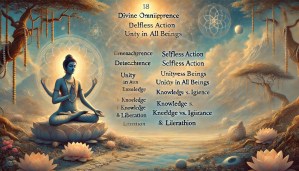
Summary of 18 Mantras
The Ishavasya Upanishad, consisting of 18 mantras, teaches that the entire universe is pervaded by the Supreme Being (Isha), and we should live with renunciation and detachment, enjoying life without greed. It emphasizes selfless action (karma yoga) while pursuing spiritual knowledge (jnana) to realize the eternal Self (Atman). The Upanishad highlights the need to balance material life with spiritual wisdom, understanding both ignorance (Avidya) and knowledge (Vidya). It warns against desires and covetousness, encouraging contentment and ethical living. Ultimately, it guides seekers toward liberation (Moksha) through truth, self-realization, and oneness with the Divine. For More Information Click Here
Key Messages of All 18 Mantras at a Glance
- The entire universe is pervaded by the Supreme; live with renunciation and do not covet others’ wealth
- Perform selfless actions for a hundred years to avoid being bound by karma.
- Those who deny the Self fall into deep darkness and live in ignorance.
- The Self is motionless yet faster than the mind; it is beyond human comprehension.
- The Self moves and doesn’t move, is far and near, and resides in all beings.
- The wise see the Self in all beings and all beings in the Self.
- Seeing the Self everywhere, one transcends sorrow and delusion.
- The Supreme is all-pervading, formless, radiant, and beyond ignorance and imperfection.
- Those who focus only on ignorance fall into darkness; those who focus only on knowledge fall into greater darkness.
- By combining both knowledge and ignorance, one overcomes death and attains immortality.
- One who knows both the manifest (Avidya) and the unmanifest (Vidya) crosses death and gains immortality.
- Those who worship the unmanifest (Prakriti) enter darkness; those who worship the manifest (material world) enter even greater darkness.
- By knowing both the manifest and the unmanifest, one transcends death and attains ultimate freedom.
- The face of Truth is hidden by the golden vessel; reveal it for the devotee who seeks liberation.
- O Sun! Withdraw your rays so I may behold your true, pure form, which is the immortal Self.
- May my vital energies merge into cosmic energy; let my body return to nature and my Self enter immortal Truth.
- O Agni! Lead us on the right path, remove our sins, and grant us the eternal knowledge of the Self.
- Offerings to the Supreme and prayers for liberation conclude the Upanishad’s teaching on Self-realization and eternal truth.
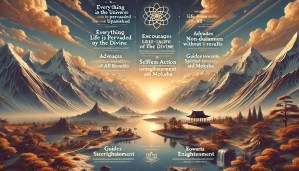
Importance of Ishavasya Upanishad
The Ishavasya Upanishad holds a central place in Vedantic philosophy as it teaches the unity of God and the universe. It emphasizes living a life of renunciation while engaging in the world, promoting detachment without abandoning action. The Upanishad bridges material life and spiritual realization, guiding one toward self-knowledge (Atma Jnana) and liberation (Moksha). Its core message—that the entire universe is pervaded by the Divine (Isha)—inspires ethical living, contentment, and inner freedom. Revered by all schools of Hindu philosophy, it is among the foundation texts of Advaita Vedanta, with profound influence on spiritual seekers and philosophers.

Conclusion
The Ishavasya Upanishad offers a timeless vision of oneness, teaching that the Divine pervades all creation. It encourages us to live with detachment, selflessness, and inner awareness, balancing worldly duties with the pursuit of spiritual knowledge. By realizing the eternal Self (Atman) within and around us, we overcome ignorance and attain true freedom and peace (Moksha). Its wisdom continues to guide seekers toward a life of harmony, contentment, and liberation.
“He who sees all beings in the Self, and the Self in all beings, never turns away from it.”
— Ishavasya Upanishad, Mantra 6
Join Our Classes:
The Upanishads are more than just ancient texts—they are timeless guides to living with clarity, balance, and inner peace. Our classes make their profound wisdom easy to understand and apply in everyday life. Join us to explore these teachings and discover a new way of seeing yourself and the world!