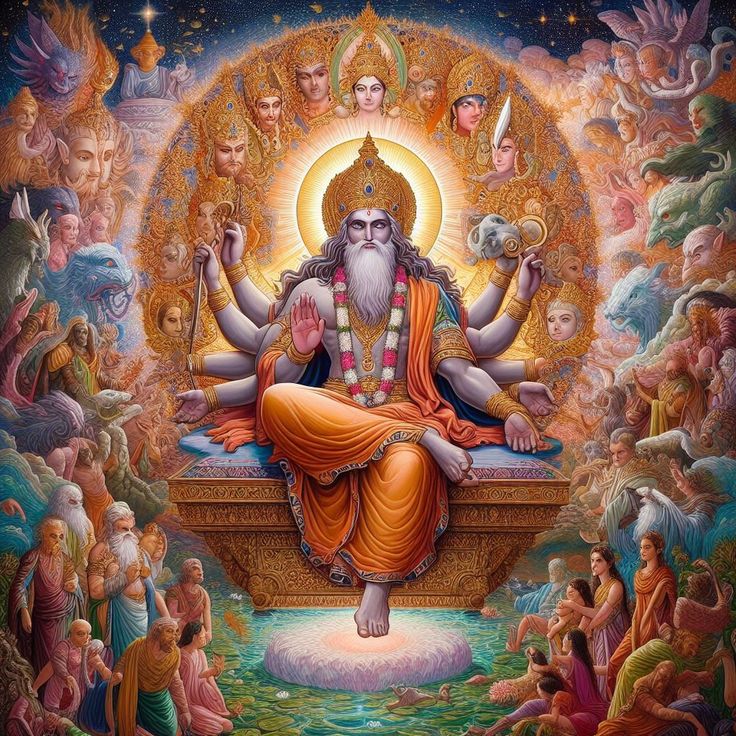
Chapter 3 – Karma Yoga (Bhagavad Gita)
In-Depth Question & Answer Explanation
1. What is the philosophical position of Chapter 3 in the Bhagavad Gita?
Answer:
Chapter 3 acts as a bridge between knowledge and action.
-
Chapter 2 introduces Jnana (knowledge of the Self)
-
Chapter 3 explains how that knowledge is lived in the world
Karma Yoga is the practical application of spiritual wisdom.
In other words:
👉 Wisdom without action is incomplete.
👉 Action without wisdom is dangerous. Click Here To Access more other text.

2. Why is Arjuna’s confusion logical rather than foolish?
Answer:
Arjuna’s question reflects a classical philosophical conflict:
-
If liberation comes from knowledge,
-
why engage in worldly action which causes suffering?
This same conflict appears in:
-
Indian philosophy (Jnana vs Karma)
-
Greek philosophy (contemplation vs action)
-
Modern life (peace vs productivity)
So Arjuna represents every thinking human, not weakness. Click Here For Chapter-3.
3. How does Krishna redefine “renunciation” in Chapter 3?
Answer:
Krishna makes a radical shift:
❌ Renunciation is NOT abandoning work
✅ Renunciation is abandoning attachment
Wikipedia definition:
True renunciation lies in mental detachment, not physical withdrawal.
Expanded meaning:
-
A monk can be mentally attached
-
A householder can be inwardly free
So spirituality is state of mind, not lifestyle choice. Click Here For Chapter-3.
4. What does “action is unavoidable” really mean?
Answer:
Krishna says:
“No one can remain without action even for a moment.”
This is a law of existence, not advice.
Deeper meaning:
-
Nature (Prakriti) operates through action
-
Humans are part of nature
-
Therefore, humans must act
Even resisting action is action.
This removes the illusion of:
“I will escape consequences by doing nothing.” Click Here For Chapter-3.

5. Why is hypocrisy strongly condemned in Chapter 3?
Answer:
Krishna criticizes people who:
-
control their body
-
but let the mind indulge in desire
Wikipedia explanation:
Such a person is called a hypocrite (mithyachara).
Psychological meaning:
-
repression without understanding leads to explosion
-
suppressed desire returns stronger
Krishna supports integration, not suppression. Click Here For Chapter-3.
6. What exactly is Karma Yoga in one precise definition?
Answer:
Karma Yoga is:
Performing one’s prescribed duty with discipline,
without ego, and without attachment to results.
Breaking it down:
-
Duty → action aligned with role (Dharma)
-
Without ego → not for self-glorification
-
Without attachment → emotional balance
This transforms work into spiritual practice.
7. Why does Krishna say results are not ours?
Answer:
Because results depend on multiple factors:
-
effort
-
timing
-
environment
-
other people
-
past actions
Wikipedia view:
Humans control action, not outcome.
Expanded insight:
Attachment assumes false control over life.
Detachment restores realism and peace. Click Here For Chapter-3.
8. How does desire (Kama) destroy intelligence?
Answer:
Krishna identifies desire as the root enemy.
Process explained:
-
Desire creates obsession
-
Obsession clouds judgment
-
Clouded judgment leads to wrong action
-
Wrong action creates suffering
Modern parallel:
Addiction psychology follows the same pattern.
Thus, desire hijacks intelligence. Click Here For Chapter-3.
9. What is the symbolic meaning of Yajna in Chapter 3?
Answer:
Yajna does not only mean ritual sacrifice.
Wikipedia meaning:
Action performed for cosmic harmony and collective welfare.
Deeper meaning:
-
Giving without demand
-
Participating in life selflessly
-
Understanding interdependence
Yajna creates balance between:
-
individual
-
society
-
nature Click Here For Chapter-3.
10. Why is selfless action said to “purify” the mind?
Answer:
Because ego is the source of mental noise.
Selfless action:
-
reduces comparison
-
reduces pride and shame
-
reduces fear of judgment
Wikipedia explanation:
Karma Yoga prepares the mind for higher wisdom.
Purification = reduction of ego-based disturbance. Click Here For Chapter-3.
11. What does Svadharma mean and why is it critical?
Answer:
Svadharma means one’s own duty according to nature and role.
Krishna says:
Better to fail in one’s own duty than succeed in another’s.
Why?
-
imitation creates inner conflict
-
authenticity creates stability
Modern relevance:
Living someone else’s expectations causes burnout. Click Here For Chapter-3.
12. Why does Krishna emphasize action for leaders?
Answer:
Krishna explains:
Society follows the actions of the respected.
Wikipedia idea:
Leaders shape norms unconsciously.
If capable people abandon duty:
-
disorder increases
-
irresponsibility spreads
So Karma Yoga has a social dimension, not just personal.
13. Is Karma Yoga compatible with modern professional life?
Answer:
Yes — more than ever.
It applies to:
-
ethical work
-
stress management
-
burnout prevention
-
purpose-driven careers
It teaches:
-
effort without obsession
-
ambition without anxiety
-
success without ego Click Here For Chapter-3.
14. How does Chapter 3 prepare the mind for later chapters?
Answer:
Chapter 3:
-
disciplines action
-
reduces ego
-
stabilizes emotions
Only such a mind can:
-
understand higher knowledge (Chapter 4–6)
-
practice meditation (Chapter 6)
-
realize devotion (Chapter 12)
Thus, Karma Yoga is the foundation.
15. What is the ultimate message of Chapter 3?
Answer:
Life cannot be avoided.
But bondage can be avoided.
Action binds when driven by desire.
Action liberates when driven by duty and awareness. Click Here For Chapter-3.
Final Extended Summary
Chapter 3 of Bhagavad Gita teaches that:
-
Action is inevitable
-
Attachment is optional
-
Desire is the enemy of wisdom
-
Selfless action purifies the mind
-
Right action leads to inner freedom
It transforms ordinary work into a spiritual path.