What is Keno Upanishad ?
The Keno Upanishad is an ancient Indian spiritual text that belongs to the Sama Veda tradition. It is one of the primary Upanishads, also known as Mukhya Upanishads. The name “Keno” comes from the first word of the text, which means “by whom”. The Keno Upanishad asks deep questions about the source of our consciousness and life. It investigates:
- By whom is the mind directed?
- Who makes the body live?
- What power enables us to see, hear, and think?
The answer it gives is Brahman, the Supreme Reality. Everything in the universe works because of Brahman, but Brahman itself is beyond the reach of the senses and intellect.
Key Teachings of Keno Upanishad
- Brahman is the power behind all senses and actions.
- Brahman is beyond the mind, speech, and senses.
- True knowledge is realizing Brahman within yourself.
- Humility is essential—power comes from Brahman, not from ego.
- The Self (Atman) is one with Brahman.
The Keno Upanishad teaches that Brahman is the unseen power behind all life and knowledge, and realizing this truth leads to self-awareness and liberation.
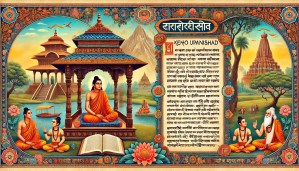
Shankaracharya’s Teachings on Brahman in the Keno Upanishad
Shankaracharya uses the Keno Upanishad to teach that realizing Brahman as your true Self leads to liberation (moksha), and that Brahman is beyond all sense perception but is the essence of everything.
- Brahman is the source and support of all actions, senses, and thoughts, yet it is beyond human perception and intellect.
- You cannot know Brahman through ordinary means (like sight, hearing, or thinking); it can only be realized through direct experience in deep meditation and self-inquiry.
- Shankara emphasizes Advaita (non-duality)—there is no difference between the individual self (Atman) and Brahman, the supreme reality.
- He reminds us that ego and pride (like those shown by the gods in the story) are illusions; true power and knowledge belong to Brahman alone.

Keno Upanishad 34 Verses Summary
The Keno Upanishad, consisting of 34 verses, explores the source of all perception, thought, and life. It begins by questioning who empowers the senses and mind, revealing that Brahman is the unseen force behind all existence. The text explains that Brahman cannot be known through the senses or intellect but is realized through self-awareness and direct experience. A story illustrates how even the gods owe their power to Brahman, teaching the importance of humility. The Upanishad guides seekers to transcend ego and realize the unity of the Self (Atman) and Brahman. Realizing this truth leads to liberation, immortality, and ultimate peace.
Arrangement of 34 Verses
Section 1 (Mantras 1–8):
-
- Brahman is subtle and difficult to understand, but it can be realized by a pure mind through meditation.
- It shines as lightning and can be known in flashes of intuition.
- Those who realize Brahman gain self-knowledge, freedom, and peace in this life.
Section 2 (Mantras 1–5):
-
- Brahman cannot be known by ordinary knowledge.
- If you think you fully know Brahman, you have understood only a little.
- Brahman is realized by those who know that they do not know it in the usual sense—this is the paradox of true knowledge.
- Realizing Brahman leads to immortality and freedom from sorrow.
Section 3 (Mantras 1–12):
-
- A story explains how the gods (Agni, Vayu, Indra) became proud after defeating demons.
- Brahman appears as a mysterious spirit (Yaksha) to humble them.
- The gods realize that their power comes from Brahman, not themselves.
- Indra approaches Uma (Parvati), who reveals to him the truth of Brahman.
Section 4 (Mantras 1–9):
-
- The student asks: “By whom is the mind directed? Who empowers the senses?”
- The teacher answers: It is Brahman, the unseen power behind the mind, speech, sight, hearing, and life-force.
- Brahman is beyond the senses—it cannot be seen, heard, or thought about, but it is that by which we see, hear, and think.
One-Line Explanation of All 34 Verses of the Keno Upanishad
-
- Who directs the mind and senses towards their objects?
- It is Brahman, the power behind speech, sight, hearing, and thinking.
- Brahman is beyond perception; it cannot be seen or heard.
- It is that by which the ear hears and the eye sees.
- Brahman is beyond comprehension and ordinary knowledge.
- It is known only by realizing that it cannot be known by the mind.
- He who thinks he knows Brahman doesn’t fully know it.
- Those who truly know realize Brahman is beyond knowing and unknowing.
- Realization of Brahman leads to freedom from sorrow and immortality.
- Brahman is present in everything and everywhere.
- Seeing Brahman in all leads to fearlessness and truth.
- Ignorance of Brahman leads to sorrow and delusion.
- By knowing Brahman in life, one attains true freedom.
- If not known here, one remains trapped in the cycle of birth and death.
- Realizing Brahman gives one strength and wisdom in this very life.
- A parable tells of gods becoming proud after defeating demons.
- Brahman appears as a mysterious being (Yaksha) to humble them.
- Agni approaches the Yaksha and fails to identify it.
- Agni is unable to burn a simple straw, showing his limits.
- Vayu then approaches the Yaksha, trying to understand it.
- Vayu too fails to move the straw, realizing his limitations.
- Indra goes next but finds the Yaksha has disappeared.
- Indra meets Uma (Parvati), who reveals the Yaksha is Brahman.
- The gods learn their power comes from Brahman, not themselves.
- Brahman’s knowledge brings true greatness and victory.
- Indra becomes the greatest among gods due to this realization.
- The lesson is to know Brahman as the source of all strength.
- Those who realize Brahman overcome ignorance and gain immortality.
- Brahman is realized as a sudden flash, like lightning.
- It is perceived by the purified mind and clear insight.
- Knowing Brahman leads to the cessation of sorrow and delusion.
- Realization brings ultimate peace, beyond duality and ignorance.
- It gives the knower a sense of fulfillment and spiritual joy.
- The Upanishad concludes by affirming liberation through Brahman’s knowledge.
The 34 verses guide us to understand that Brahman is the unseen, ultimate reality behind all existence, and realizing it leads to self-realization and liberation.
Conclusion
The Keno Upanishad teaches that the Supreme Reality, Brahman, is the unseen power behind all perception, thought, and action. It cannot be known through the senses or the intellect but is realized through self-awareness and inner experience. The Upanishad emphasizes humility, self-inquiry, and direct realization as the path to understanding Brahman, leading to liberation (moksha) and immortality. Ultimately, it guides us to recognize that the Self (Atman) is not different from Brahman, and realizing this truth brings freedom from ignorance and sorrow.
“Brahman is not an object of knowledge; it is That by which all knowing is possible.”
Join Our Classes:
The Upanishads are more than just ancient texts—they are timeless guides to living with clarity, balance, and inner peace. Our classes make their profound wisdom easy to understand and apply in everyday life. Join us to explore these teachings and discover a new way of seeing yourself and the world!