
Understanding Reality Beyond Duality: Gaudapada’s Teachings
In these verses, Gaudapada expounds on the nature of reality as non-dual consciousness, transcending the apparent dualities of waking and dream states. He explains that the perceived differences arise due to ignorance (avidya), which veils the one true self. The phenomenal world and its distinctions are likened to illusions or dreams, lacking ultimate reality. By realizing the non-dual self beyond mind and senses, one attains supreme peace (Alatashanti) and liberation. This teaching forms the core of Advaita Vedanta, emphasizing the oneness of existence. Ultimately, these verses guide the seeker toward the realization that the absolute truth is beyond all descriptions and distinctions. For More Information Click Here
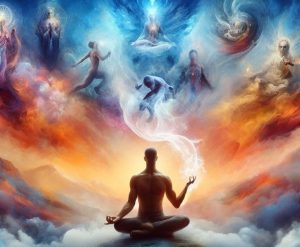
Gaudapada Karika Chapter 4 (Alatashanti Pada): Karikas 29-40 — The Non-Dual Reality Beyond Duality and Illusion
Karika 29
There is no real difference between the two states of consciousness, waking and dream; the difference is only apparent, like clay and the pot made from it.
Explanation: The waking and dream states are not fundamentally different; they are only distinguished by name and form, but underlying consciousness remains the same.
Karika 30
The reality underlying both waking and dream states is the one immutable consciousness, without any multiplicity.
Karika 31
The duality experienced in waking and dream is an illusion caused by ignorance (avidya); once the illusion is removed, only the non-dual reality remains.
Karika 32
The cause of this illusion is avidya (ignorance), which superimposes multiplicity on the one without a second.
Karika 33
The supreme consciousness is unborn, changeless, and transcends the triad of waking, dream, and deep sleep states.

Karika 34
When the body and mind cease their function, the ego and the notion of individuality disappear, revealing the true self as pure consciousness.
Karika 35
The universe, like a dream, is unreal and arises only due to ignorance and mental projections.
Karika 36
Similarly, the states of consciousness are like waves on the ocean, temporary and without true substance.
Karika 37
Understanding the non-dual self leads to liberation, where all distinctions cease and one abides in peace.
Karika 38
The mind’s modifications and dualistic thoughts vanish in the realization of the absolute self.
Karika 39
One who realizes the self beyond the mind and senses is freed from the cycle of birth and death. For More Information Click Here
Karika 40
This highest truth is beyond all description, beyond the reach of senses and mind, yet it is the sole reality.

Adi Shankaracharya’s Insights on Gaudapada Karika 4.29-40
-
Non-Dual Reality Beyond States of Consciousness:
Shankara emphasizes that waking, dream, and deep sleep are mere modifications (vrittis) of the mind, not the true self. The self (Atman) is unchanging, eternal, and beyond these transient states, just as Gaudapada explains. -
Illusion (Maya) and Ignorance (Avidya):
Shankara elaborates that the world’s duality and multiplicity are due to avidya, a fundamental ignorance that causes superimposition (adhyasa). The distinctions perceived in waking and dream states arise because of this ignorance. -
The Self is Pure Consciousness (Chit):
Shankara teaches that the Atman is pure consciousness, unaffected by the body-mind complex. Realizing this self through knowledge (jnana) dissolves all false identifications and distinctions. -
The World is Like a Dream or Illusion:
Echoing Gaudapada, Shankara uses metaphors like dream, mirage, or magic show to describe the phenomenal world’s unreality. Once the veil of ignorance is lifted, the non-dual truth alone remains. -
Liberation (Moksha) through Self-Realization:
Shankara stresses that liberation is attained by recognizing the non-dual self, beyond the mind and senses, leading to the cessation of all suffering and duality. -
Beyond Description:
True reality transcends all language and mind concepts. Shankara concurs that the absolute is beyond all descriptions, affirming silence (mauna) as the ultimate expression of the highest truth. For More Information Click Here

Conclusion
In conclusion, these verses reveal the fundamental Advaita truth that the self is beyond all dualities and states of consciousness. The world’s distinctions are illusory, caused by ignorance, and dissolve upon true knowledge of the non-dual reality. Adi Shankaracharya’s insights reinforce this, emphasizing that liberation arises from realizing the immutable pure consciousness within. This realization transcends all mental concepts and sensory experiences, leading to supreme peace and freedom. Thus, the teachings invite the seeker to look beyond appearances and rest in the unchanging, eternal self. Ultimately, the path is one of knowledge that dispels ignorance and reveals the oneness of existence.
Join Our Classes:
The Upanishads are more than just ancient texts—they are timeless guides to living with clarity, balance, and inner peace. Our classes make their profound wisdom easy to understand and apply in everyday life. Join us to explore these teachings and discover a new way of seeing yourself and the world!