Introduction to the Four States of Consciousness in the Mandukya Upanishad
The Mandukya Upanishad, one of the shortest yet most profound Upanishads, explores the nature of the self through four states of consciousness. In Chapter 2, Karikas 11 to 28, Gaudapada explains the waking, dreaming, and deep sleep states, revealing their transient and illusory nature. These three states are experienced by the individual self, but they do not represent the ultimate reality. Beyond them lies the fourth state, Turiya, which is pure, non-dual consciousness and the true essence of the self. This section illuminates the journey from ignorance to self-realization, emphasizing the unity underlying all experiences. Understanding these states is key to grasping the core of Advaita Vedanta philosophy. For More Information Click Here
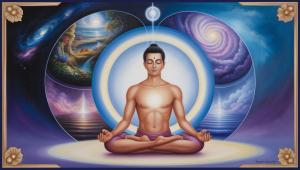
Exploring the Self Beyond the Three States: Commentary on Mandukya Upanishad Karikas 11 to 28
Karika 11:
The waking state (Vaishvanara) is the first condition of the self, where the individual perceives the external world through the senses. This state is limited by physical and mental activity, experiencing multiplicity.
Karika 12:
The waking consciousness is outward-directed, involving interaction with gross objects, hence it is characterized by external awareness and multiplicity.
Karika 13:
Though the waking state is experienced as real, it is ultimately transient and limited, akin to a dream compared to the true consciousness.
Karika 14:
The dream state (Taijasa) is the second condition of the self, where the mind perceives subtle objects, not gross ones. It is inward-directed and subjective.
Karika 15:
In the dream state, the individual experiences a world created by the mind without direct contact with external senses, reflecting the mind’s creative power.
Karika 16:
The dream state is subtler than waking but still unreal, as its objects are mental constructions and do not have independent reality.
Karika 17:
The deep sleep state (Prajna) is the third condition of the self, characterized by the absence of desires and mental activity, a state of blissful ignorance. For More Information Click Here
Karika 18:
In deep sleep, the self is unified, undivided, without experience of objects, and the mind is not active.
Karika 19:
Deep sleep consciousness is the basis for the bliss experienced during that state, as there is no division or duality.
Karika 20:
Although deep sleep appears as non-experience, it is in fact a state of pure consciousness, where the self exists in a latent, unmanifested form.
Karika 21:
All three states (waking, dreaming, deep sleep) have a common underlying self, which is constant and unchanging.
Karika 22:
The self is present in all three states, but its real nature is hidden by the modifications of the mind and body.
Karika 23:
The three states are different manifestations or modifications (upadhis) imposed on the one self, which is beyond all states.
Karika 24:
The three states are like illusions caused by the mind; the ultimate reality is the self, which is beyond these states.
Karika 25:
The fourth state (Turiya) transcends waking, dreaming, and deep sleep; it is pure consciousness, non-dual and blissful.
Karika 26:
Turiya is the true nature of the self, untouched by the phenomena of the three states, and is the goal of realization.
Karika 27:
Turiya is beyond words and thought, the silence beyond all sounds and concepts, the essence of the self.
Karika 28:
Realizing Turiya leads to liberation (moksha), as it destroys all ignorance and duality, revealing the unity of self and Brahman.
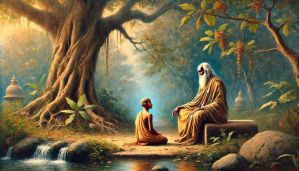
Adi Shankaracharya’s Insights on Mandukya Upanishad Chapter 2 (Karikas 11–28):
-
The Three States Are Apparent, Not Absolute
Shankara explains that waking (Jagrat), dreaming (Svapna), and deep sleep (Sushupti) are merely apparent states of the individual self (jiva), shaped by the mind and senses. These states are transient and do not reveal the true nature of the self. -
The Self Is One and Immutable
Despite the changes in experience across these three states, the self remains one, immutable, and unaffected. The individuality perceived in these states is due to the association with the body-mind complex (upadhis). -
Dream State Reveals the Subtle Mind
In the dream state, the self experiences subtle objects created by the mind itself, indicating the mind’s power to project reality, yet this too is not ultimate truth. -
Deep Sleep State Is a State of Undifferentiated Bliss
Deep sleep is characterized by the absence of duality and mental activity. Though ignorance of objects prevails, there is an experience of bliss, which Shankara interprets as a glimpse of the self’s true nature but still veiled. For More Information Click Here -
Turiya: The Fourth State Beyond Phenomena
Shankara emphasizes Turiya as the transcendental reality beyond waking, dreaming, and deep sleep. It is pure consciousness (Chit), beyond all duality, and the true nature of Atman, which is identical with Brahman. -
Realization of Turiya Brings Liberation
According to Shankara, the knowledge (jnana) of Turiya dispels ignorance and the false identification with the three states. This realization alone leads to moksha—liberation from the cycle of birth and death. -
Non-Duality Is the Core Teaching
He asserts that all distinctions of subject and object, time and space, are transcended in Turiya. The self is non-dual and infinite, and recognizing this dissolves all illusions.
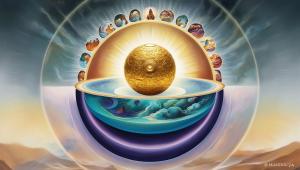
Conclusion
The Mandukya Upanishad reveals that waking, dreaming, and deep sleep are temporary states veiling the true self. Beyond these is Turiya, the pure, non-dual consciousness that is the essence of our being. Adi Shankaracharya’s commentary emphasizes that realizing this fourth state dissolves all ignorance and duality. Liberation arises when one transcends identification with the mind and body and abides in this eternal awareness. Thus, the journey through the three states leads to the ultimate realization of oneness with Brahman. Understanding and abiding in Turiya is the highest spiritual goal in Advaita Vedanta.
Join Our Classes:
The Upanishads are more than just ancient texts—they are timeless guides to living with clarity, balance, and inner peace. Our classes make their profound wisdom easy to understand and apply in everyday life. Join us to explore these teachings and discover a new way of seeing yourself and the world!