Introduction
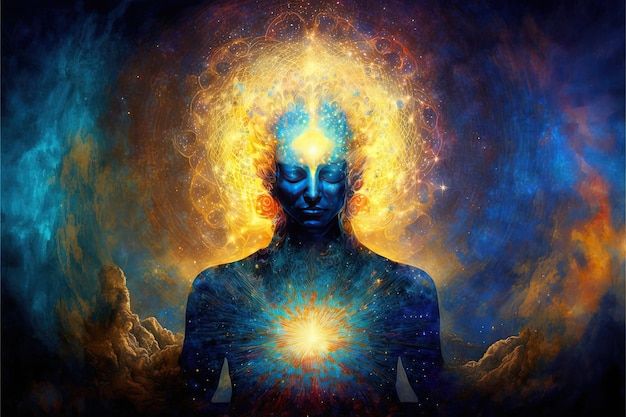
Meditation – Nonverbal “I Am” is a profound Vedantic practice developed to guide the aspirant into the heart of pure being—beyond the mind, identity, and language. Rather than relying on concepts or words, this meditation invites a direct experience of I Am as an unfathomable, timeless presence, awakening the meditator to their true nature, the Ātman. It is the practice of abiding in the non-verbal essence of being, unmediated by thought, emotion, or cultural constructs Click Here To More Detail.
Themes
- Physical Readiness & Inner Alertness
Begin by sitting upright with alert awareness, eyes softly closed, and a gentle smile—creating both physical ease and subtle mental alertness - Dropping the Mental Content
Simply release all thoughts, labels, and mental narratives—allow the mind to become wordless. The aim is to drop notions, internal dialogue, and conceptualization completely, entering a state of pure, silent presence - Being the Non-Verbal “I Am”
Instead of the usual perceiving or thinking “I am this,” become the feeling of “I am” located in the heart. This “I am” is not a mental concept—it’s a non-perceptual, non-emotional essence that is intrinsically present - Releasing All Identity Constructs
As this nonverbal “I am,” you are neither good nor bad, nor tied to nationality, relationship status, gender, age, or any worldly role. The practice invites freedom from all identifications, cultural or personal Click To PDF. - Timeless, Spaceless Awareness
Does this “I am” exist within past or future constructs? No—it is timeless and spaceless, revealing its nature as the Ātman, the substratum beyond all transience
- Self-Inquiry (Atma Vichāra)
From this wordless state, inquire into the nature of the Self: As the nonverbal “I am,” are you young or old? Male or female? Single or relating? By questioning, the limitations collapse, pointing to the pure being that is beyond all qualifiers. - Unity of Inner & Outer Being
Upon opening the eyes, a realization dawns: inner and outer are one when there is no identification. Inside and outside distinctions dissolve in the depths of this wordless being. - Atma as the Only Reality
In this state, you realized—I am equals Ātman, the only true being (Sat), the cause of the universe (Jagat Karanam). It is your own nature, untouched by form or naming. Even scriptures like Tat Tvam Asi emerge from, but soon give way to, the silence of pure being. Click To PDF. - Beyond Words—Into Silence
Words may guide you to this threshold, but they have done their work. As you abide in this inner being, language falls away. There is no scripture, no concept—only living presence. - Self-Abidance Through Releasing Identification
The practice culminates in abiding as the Self. The moment you shift identification back to the world or mental concepts, you forget your own being, becoming a part of saṁsāra again. Realizing and abiding in this I am is considered the highest spiritual sādhanā: Ātma Vichāra.
Benefits of the Practice
- Calms the Mind by going beyond the realm of thoughts and labels.
- Frees from Identity-Based Distress, because it dissolves emotional attachments rooted in personal and societal identities.
- Establishes Direct Self-Knowledge, not mediated by scripture or reasoning, but by pure presence.
- Anchors in Unity and Immortality, revealing your existence as the one undivided being beyond time, space, and duality. Click To PDF.
Why Study This
This meditation is more than a practice—it is a doorway to the direct realization of Advaita Vedanta’s central truth: Tat Tvam Asi (“That Thou Art”).
By stripping away all mental constructs, it allows you to live the teaching, not just understand it. It’s a bridge from conceptual knowledge to non-dual experience, ideal for those seeking spiritual maturity and liberation.
How Often to Practice
While this particular text doesn’t prescribe a ritual frequency, general wisdom from Vedanta Students (e.g., 10 minutes of Meditation as Sakshi daily) applies well.
- Daily Short Sessions: Start with 5–15 minutes of quiet sitting, following the guided steps.
- Regular Integration: Gradually extend the session, entering the wordless realm more naturally.
- Resurface and Rejoin: After plunging into silent being, emerge gently—carry the inner realized “I am” into your daily life. Click To PDF.
Conclusion
Meditation – Nonverbal “I Am” is a potent practice in Vedanta that dissolves ego, thought, and identification, unveiling your being as the one undivided consciousness—the Ātman.
- Sit alert, relaxed, and smile.
- Drop all mental and linguistic content.
- Abide as the pure “I am,” free from identity.
- Realize the timeless, spaceless being.
- Let words fall away.
- Abide as the Self, not the person.
This is the heart of Atma Vichāra—self-inquiry leading to Self-abidance. It is not theoretical, but existential: you live as the realization itself.
Join Our Classes:
The Meditation are more than just ancient texts—they are timeless guides to living with clarity, balance, and inner peace. Our classes make their profound wisdom easy to understand and apply in everyday life. Join us to explore these teachings and discover a new way of seeing yourself and the world!