What is Mundak Upanishad ?
The Mundak Upanishad is one of the major ancient Indian spiritual texts. It belongs to the group of 108 Upanishads, specifically categorized under the Atharva Veda. The name “Mundak” comes from the Sanskrit word “Munda”, which means “shaved”—symbolizing a person who renounces worldly life (like a monk) in pursuit of higher knowledge.
One of the most quoted lines from the Mundak Upanishad:
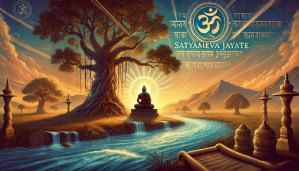
“Satyameva Jayate”
(सत्यमेव जयते)—“Truth alone triumphs.”
This phrase was adopted as the national motto of India. For More Information Click Here
Key Teachings of Mundak Upanishad
Two Types of Knowledge
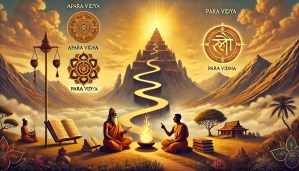
- Apara Vidya: Lower knowledge (rituals, scriptures).
- Para Vidya: Higher knowledge (realization of Brahman).
Brahman is the Ultimate Reality
- Eternal, infinite, and the source of everything.
- Realizing Brahman leads to liberation (Moksha).
Rituals Can’t Give Liberation
- Rituals offer temporary results, not eternal freedom.
- Only self-knowledge liberates.
Renunciation and Self-Knowledge Are Essential
- Seek a Guru, practice meditation, and realize the Self.
The Two Birds Metaphor
- One bird (soul) enjoys; the other (Supreme Self) observes.
- Realize your true Self as Brahman.
Truth Alone Triumphs (Satyameva Jayate)
- Truth leads to liberation and immortality.
Adi Shankaracharya’s teachings on the Mundak Upanishad
Adi Shankaracharya’s commentary on the Mundak Upanishad emphasizes Jnana (self-knowledge) as the sole means to liberation, beyond rituals and karma. He explains that realizing the identity of the individual self (Atman) with Brahman destroys ignorance and ends the cycle of birth and death. Shankaracharya highlights the futility of external actions without inner realization and guides seekers towards renunciation and meditation. His teachings affirm that Brahman is the ultimate truth, and knowledge of it leads to Moksha (liberation).

Mundak Upanishad’s 64 Verses Summary
The Mundak Upanishad explains two kinds of knowledge—Apara Vidya (lower knowledge of rituals and scriptures) and Para Vidya (higher knowledge of Brahman). It teaches that realizing the Supreme Brahman is the path to liberation, not through rituals but through self-knowledge and meditation. Using powerful imagery, like two birds on a tree, it shows the difference between the individual soul and the Supreme Self. The Upanishad emphasizes renunciation, truth, and purity as the foundation for spiritual realization. It describes Brahman as the source, sustainer, and goal of all creation—self-luminous and eternal. Ultimately, it declares that truth alone triumphs (Satyameva Jayate), leading the seeker to immortality and freedom. For More Information Click Here
Mundaka Upanishad Structure & Explanation
First Mundaka
- Contains 22 mantras (verses)
- Theme: Two kinds of knowledge and the nature of Brahman.
-
- Shaunaka approaches Sage Angiras, asking for supreme knowledge.
- Angiras explains Apara Vidya (lower knowledge—rituals, Vedas) and Para Vidya (higher knowledge—Brahman).
- Brahman is the source of creation; everything originates from Him.
- The cosmic process is described—how the universe and beings are created.
- Rituals are declared limited; they give temporary results and cannot lead to liberation.
- The seeker is encouraged to seek Brahman for ultimate freedom.
Second Mundaka
- Contains 21 mantras (verses)
- Theme: The limitations of rituals and the path to Brahman through renunciation and meditation.
-
- Those who are wise give up rituals after understanding their limitations.
- They approach a Guru to gain higher knowledge.
- The two birds metaphor is introduced:
- One bird represents the Jivatma (individual soul), enjoying life.
- The other represents Paramatma (Supreme Self), merely witnessing.
- Realizing unity with Brahman leads to freedom from sorrow.
- The self-luminous Brahman is described as the light behind all lights.
- Meditation and truthfulness purify the seeker and prepare them for realization.
Third Mundaka
- Contains 21 mantras (verses)
- Theme: The state of liberation and the final realization of Brahman.
-
- The disciplined seeker attains Brahma-loka and eventually merges with Brahman.
- Truth (Satyam), self-control, and knowledge lead to liberation.
- The seeker realizes Brahman is all-pervading, pure consciousness.
- The famous phrase “Satyameva Jayate” declares that truth alone triumphs.
- Upon realization, the soul is freed from all bondage and attains immortality.
- The Upanishad concludes with the peace mantra, indicating completeness and fulfillment.
First Mundaka (22 Verses)
First Khanda (1–9)
- Shaunaka approaches Sage Angiras seeking supreme knowledge.
- Angiras explains there are two types of knowledge: higher (Para) and lower (Apara).
- Lower knowledge includes the study of the Vedas and rituals.
- Higher knowledge is realization of the imperishable Brahman.
- Brahman is the unseen cause of all creation.
- From Brahman, all beings and the universe emerge.
- He created Tapas (austerity), Dharma (righteousness), and Brahmacharya (discipline).
- Those who perform rituals with ignorance stay in darkness.
- The rituals performed with desire lead only to temporary results.
Second Khanda (10–22)
- Fools think ritualistic actions are the ultimate path but wander in ignorance.
- Rituals give temporary merit but not liberation.
- Wise ones give up ritualistic works and seek higher truth.
- They approach a Guru to gain knowledge of Brahman.
- Brahman is beyond sense perception, subtle and eternal.
- The Supreme Self is the light of all lights.
- Realizing Brahman removes all ignorance and bondage.
- From Brahman arise all forms and beings in the universe.
- Like sparks from a fire, all beings emerge from Brahman.
- Brahman is both immanent and transcendent.
- He who realizes Brahman becomes immortal.
- Truth, Tapas, and knowledge lead one to Brahman.
- The knower of Brahman attains all and transcends sorrow.
Second Mundaka (21 Verses)
First Khanda (1–10)
- The universe arises from Brahman as its source.
- Brahman is the inner controller of all beings.
- From Him arise Prana (life), mind, and senses.
- The world is sustained by Him through His power.
- The seeker must renounce ignorance and seek Brahman.
- Those engaged in rituals are like blind men led by the blind.
- Fools deluded by ritualistic merit remain in bondage.
- Rituals lead to heaven, but heaven is impermanent.
- Only Self-knowledge frees one from the cycle of birth and death.
- Renouncing desires and approaching a Guru is the true path.
Second Khanda (11–21)
- The Atman (Self) shines by its own light, illuminating everything.
- Brahman is realized by those who have pure hearts and self-control.
- Two birds dwell on the same tree—one enjoys, the other witnesses.
- The individual soul suffers due to ignorance but realizes joy when it sees the Supreme.
- When the seeker sees the shining Brahman, he is freed from sorrow.
- He who knows Brahman becomes free from all bonds.
- The pure Self is the source of all creation, untainted by actions.
- The wise realize Brahman as the cause and essence of the universe.
- Realization of Brahman brings liberation from all duality.
- Knowing Brahman as the eternal, one attains immortality.
- The pure mind alone perceives Brahman, not the unrefined.
Third Mundaka (21 Verses)
First Khanda (1–10)
- The sacred truth is revealed to the pure-hearted seekers.
- The bright path leads to Brahmaloka for the pure souls.
- Satyameva Jayate—Truth alone triumphs and leads to Brahman.
- Righteousness, truth, and self-control lead to immortality.
- The self-luminous Brahman is the inner light of all beings.
- The realized soul is liberated and unites with Brahman.
- Like rivers merging in the ocean, individual souls merge in Brahman.
- The knower of Brahman attains fearlessness and freedom from grief.
- The realized ones see Brahman in all beings and are freed from duality.
- Self-realization leads to supreme bliss and eternal peace.
Second Khanda (11–21)
- Brahman is beyond form, actionless, pure, and eternal.
- The knower of Brahman becomes one with Him and is untouched by karma.
- The seeker who knows Brahman is not reborn and attains liberation.
- The knower of Brahman transcends sin and sorrow.
- Self-realization ends all desires and grants eternal joy.
- The fire of knowledge burns away ignorance and karma.
- The realized sage becomes free like an arrow shot into the target.
- The Upanishad concludes by glorifying the teaching and the teacher.
- Those who study and teach this knowledge attain Brahman.
- The peace chant invokes harmony and protection for the seeker.
- Om! Peace! Peace! Peace! (Shanti mantra for completeness and serenity).
Conclusion
The Mundak Upanishad teaches that true knowledge lies in realizing the imperishable Brahman, not in rituals or external actions. It guides seekers from ignorance to wisdom, emphasizing renunciation, meditation, and the pursuit of truth. By realizing the oneness of the individual self (Atman) with the Supreme (Brahman), one attains liberation and immortality. Ultimately, it declares that truth alone triumphs (Satyameva Jayate), leading to eternal freedom and peace.
Join Our Classes:
The Upanishads are more than just ancient texts—they are timeless guides to living with clarity, balance, and inner peace. Our classes make their profound wisdom easy to understand and apply in everyday life. Join us to explore these teachings and discover a new way of seeing yourself and the world!