What is Svetasvatara Upanishad?
The Svetasvatara Upanishad is a revered ancient Sanskrit text and part of the Yajurveda. It explores deep philosophical ideas about the nature of the ultimate reality, Brahman, and the individual soul, Atman. The Upanishad introduces the concept of a personal God, often referring to Rudra, later identified with Shiva, as the supreme being. It emphasizes meditation, self-discipline, and devotion as means to attain spiritual realization. The text harmonizes Samkhya and Vedantic philosophies, blending theistic devotion with knowledge of the Self. Its teachings inspire seekers to understand the oneness behind all creation and liberate themselves from the cycle of rebirth. For More Information Click Here
Key Themes of the Svetasvatara Upanishad
-
Nature of the Supreme Reality (Brahman): It identifies Brahman as the ultimate cause and essence of the universe, often associated with Rudra/Shiva as a personal God.
-
Atman and Brahman Unity: The Upanishad teaches that the individual soul (Atman) is ultimately one with Brahman, leading to liberation (moksha).
-
Role of Devotion (Bhakti): It introduces the concept of personal devotion to God as a valid path to spiritual realization.
-
Yoga and Meditation: Emphasizes disciplined practice, meditation, and self-control (yoga) as essential for realizing the Self.
-
Cosmic Order and Creation: Discusses the mystery of creation, attributing it to a divine will rather than random chance or purely material causes.
-
Liberation from Bondage: Explains how ignorance causes bondage and how knowledge, meditation, and devotion lead to freedom from the cycle of birth and death.
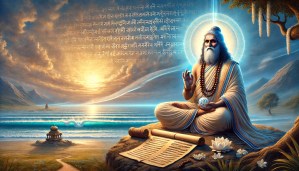
Adi Shankaracharya’s Advaitic Interpretation
Adi Shankaracharya interpreted the Shvetashvatara Upanishad through the lens of Advaita Vedanta, emphasizing the non-dual nature of Brahman. While the text mentions Rudra or Shiva as the Supreme, Shankara explains that these names point to the formless, attributeless Brahman, beyond all distinctions. He teaches that the individual self (Atman) and the Supreme Brahman are one and the same, and realizing this unity leads to liberation (moksha). Shankara clarifies that references to a personal deity are for meditation purposes, ultimately guiding seekers to transcend duality and recognize Brahman as the only reality. For More Information Click Here
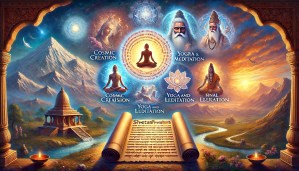
Chapter-Wise Summary of the Shvetashvatara Upanishad
Chapter 1 – The Inquiry into the Cause of the Universe
- The sages ask: What is the cause of the universe? Is it Time, Nature, Necessity, or a Divine Being?
- Concludes that the cause is Brahman, the Supreme Self who is beyond all.
Chapter 2 – The Nature of the Supreme
- Introduces Rudra as the one God who rules the world.
- The Supreme Purusha (Person) is the cause of the world and beyond Maya (illusion).
Chapter 3 – Meditation and Yoga
- Describes Yoga as the path to realizing Brahman.
- Through meditation, the Yogi sees the Divine Self shining like a sun.
Chapter 4 – The One God in Many Forms
- Affirms Rudra as the Supreme Being, present in all forms.
- Stresses monotheism and unity of all existence in the One Lord.
Chapter 5 – The Self and Liberation
- The Jiva (individual soul) and Paramatma (Supreme Self) are like two birds on a tree: one eats the fruit (karma), the other watches (witness).
- Liberation is through knowing Brahman.
Chapter 6 – Final Realizations and Freedom
- The Self is beyond birth and death.
- Knowing Shiva (Rudra) as the Supreme, one attains Moksha (liberation).
Verses
- Verse 1 – Philosophers question the origin of the universe: Is it Brahman, Time, Nature, or Chance? The inquiry leads to understanding Brahman as the ultimate, non-dual cause.
- Verse 2 – The world’s cycle is driven by ignorance (avidya); realization dawns that the Self (Atman) alone exists, untouched by Time and action, as the supreme reality.
- Verse 3 – The wise perceive the imperishable Brahman, free from birth and death. By knowing this, one crosses sorrow and attains the blissful, eternal Self…. To know more Click Here.

The Significance of the Shvetashvatara Upanishad
The Shvetashvatara Upanishad guides seekers from understanding the illusory nature of the world to realizing the Supreme Self, the One Reality, leading to liberation.
-
Bridges Philosophy and Devotion
It uniquely blends Jnana (knowledge) and Bhakti (devotion). While deeply philosophical, it introduces the personal God (Ishvara) concept alongside Brahman, making it accessible to both Advaita Vedanta seekers and devotional paths. -
Clarifies the Nature of Reality
It explains the relationship between Purusha (Supreme Self) and Prakriti (Nature). It teaches that realizing Purusha as the inner Self frees one from bondage, aligning with Shankaracharya’s Advaita vision of non-dual Brahman. -
Introduces the Concept of Ishvara
The Shvetashvatara Upanishad is one of the first Upanishads to explicitly mention Ishvara (the personal Lord) as the Supreme Ruler, making it foundational for both Vedantic and theistic traditions. -
Emphasizes Meditation and Yoga
It presents practical methods like meditation (dhyana) and yoga, highlighting how disciplined practice leads to Self-realization and freedom from samsara (cycle of birth and death). -
Respected by Multiple Traditions
Both Advaita Vedanta and theistic schools (like Shaivism) honor this text. Its teachings on Rudra as Brahman form the basis for many Shaiva interpretations.
Conclusion
The Shvetashvatara Upanishad beautifully integrates profound philosophical wisdom with devotion and meditation. It reveals the Supreme Reality (Brahman) as both formless and personal, the Inner Self of all beings. By realizing this non-dual truth through knowledge, yoga, and devotion, one transcends ignorance and attains liberation (moksha). Its timeless teachings inspire seekers to go beyond the illusions of the material world and realize their true nature as Brahman, the eternal, blissful Self.
“Eko hi Rudro na dvitiyaya tasthur”
“Rudra is truly one; there is no second to Him.”
(Chapter 3, Verse 2)
It emphasizes oneness, highlighting that Rudra/Shiva is the sole reality, transcending duality.
Join Our Classes:
The Upanishads are more than just ancient texts—they are timeless guides to living with clarity, balance, and inner peace. Our classes make their profound wisdom easy to understand and apply in everyday life. Join us to explore these teachings and discover a new way of seeing yourself and the world!