Understanding the Ultimate Reality in Mandukya Upanishad Chapter 3
In these profound Karikas, Gaudapada elaborates on the ultimate nature of reality as taught in the Mandukya Upanishad. He emphasizes the principle of Ajata-vada — the doctrine of non-origination — asserting that the world neither truly arises nor ceases. The Self (Ātman) is changeless, singular, and beyond all dualities of bondage and liberation. The apparent multiplicity and worldly experiences are seen as mere projections of the mind, born from imagination and limiting adjuncts. Scriptural teachings are presented as skillful means to transcend conceptual thinking and realize the non-dual truth. Ultimately, these verses guide the seeker to discern the eternal Self beyond all transient appearances. For More Information Click Here
On the Illusory World and the Eternal Self: Mandukya Upanishad Chapter 3, Verses 15-19
Karika 15
Transliteration:
Na nirodho na cotpattir na baddho na ca sādhakaḥ |
Na mumukṣur na vai mukta ityeṣā paramārthatā ||
Translation:
There is no cessation (of the world), no origination, none in bondage, none striving (for liberation), no seeker after liberation, and none liberated — this is the ultimate truth.
Explanation:
This powerful verse summarizes Ajata-vada — the doctrine of non-origination. From the paramārtha (absolute) standpoint, nothing ever truly arises, so concepts like bondage and liberation are ultimately unreal. The apparent world is a superimposition on the changeless Brahman.
Karika 16
Transliteration:
Eka eva atmanodrṣṭo vikriyo nāsti kaścana |
Saṃvṛtyā tu prapañco ‘yaṃ dṛṣṭaḥ satyena nānyathā ||
Translation:
The Self is verily one and is perceived as such. It undergoes no modification. This manifold world, however, is perceived through empirical (relative) experience — not through the ultimate truth.
Explanation:
The Self (Ātman) is changeless and one, but due to empirical (vyavahārika) perception, the world appears diversified. This distinction between paramārthika satya (absolute reality) and vyavahārika satya (conventional reality) is central to Advaita.
Karika 17
Transliteration:
Kalpitair eva vastubhir jāyate kalpanā kṛtā |
Kalpanāyāṁ vinā satyaṁ na kiñcid avatiṣṭhate ||
Translation:
The imagination (or conceptualization) arises from imagined objects alone; without such imagination, nothing of the (empirical) truth stands.
Explanation:
The world is a projection of the mind — ideas based on imagined dualities. Without imagination or conceptual division, only the non-dual reality remains. This supports the idea that mind constructs multiplicity.
Karika 18
Transliteration:
Upadeśo hi bodhārthaṁ kalpyate na tu tattvataḥ |
Akalpitaṁ hi bhāvena kalpitaṁ nāvatiṣṭhate ||
Translation:
Instruction is only meant to bring about understanding, and is not the ultimate truth. For, once the unimagined is known, the imagined does not stand anymore.
Explanation:
Scriptural teachings (upadeśa) are tools to point toward truth, not truth themselves. Once Self-knowledge is attained, all conceptual frameworks drop away — they are provisional means, not ends.
Karika 19
Transliteration:
Saṁvṛtiṁ satyam ity āhuḥ satyaṁ tv ātmaiva kevalam |
Saṁvṛteḥ pratipattis tu dvayasyopādhidarśanāt ||
Translation:
They say the relative (empirical) reality is true, but the truth is verily the Self alone. Knowledge of the relative arises due to the perception of duality created by limiting adjuncts.
Explanation:
Relative reality is considered conditionally valid, but only the Self is ultimately real. Duality arises due to upādhis (limiting adjuncts like body-mind), which veil the non-dual nature of Self. For More Information Click Here
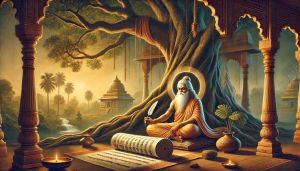
Adi Shankaracharya’s Insights on Mandukya Upanishad Karikas 15-19
-
Non-Origination (Ajata-vada) — Shankara strongly upholds Gaudapada’s teaching that the world is unborn and unreal in the highest sense. From the standpoint of paramārtha satya (absolute truth), nothing ever truly comes into existence or passes away. This nullifies all notions of creation, destruction, bondage, and liberation as ultimately illusory.
-
The Immutable Self — Shankara stresses that the Ātman is changeless, one, and eternal, untouched by the transformations of the phenomenal world. The apparent plurality arises only due to avidya (ignorance) and the superimposition of upādhis (limiting adjuncts) like body and mind.
-
World as Māyā — The multiplicity and change we experience are due to Māyā, which projects the world through avidya and imagination. This projection has no real existence in itself, and is only empirically valid.
-
Purpose of Scriptural Instruction — For Shankara, the scriptures and teachings are pramāṇas (means of knowledge) designed to remove ignorance, but they are not the ultimate truth. Once knowledge of the Self dawns, all dualistic concepts and scriptural instructions lose their independent validity.
-
Disappearance of Duality — Upon realization of the Self’s non-dual nature, the distinctions of seeker and sought, bondage and liberation, cease to exist. The limiting adjuncts (upādhis) are known to be unreal, revealing the pure consciousness that is the only reality.
-
Ultimate Goal: Self-Realization — Shankara’s commentary guides seekers to transcend the empirical level of reality and abide in the absolute oneness of Brahman, the eternal Self, which is beyond all distinctions and mental constructs. For More Information Click Here
Conclusion
These Karikas reveal the profound truth that the world of multiplicity is ultimately unreal, and the Self alone is eternal and changeless. Through the lens of Ajata-vada, all concepts of birth, death, bondage, and liberation dissolve into non-existence. Adi Shankaracharya’s insights illuminate how ignorance and limiting adjuncts veil the true nature of the Self. Scriptural teachings serve as a guide to dispel this ignorance and reveal the non-dual reality. Realizing this oneness brings the seeker beyond all dualities and suffering. Thus, the highest knowledge is the direct experience of the Self, free from all conceptual divisions.
Join Our Classes:
The Upanishads are more than just ancient texts—they are timeless guides to living with clarity, balance, and inner peace. Our classes make their profound wisdom easy to understand and apply in everyday life. Join us to explore these teachings and discover a new way of seeing yourself and the world!