Introduction
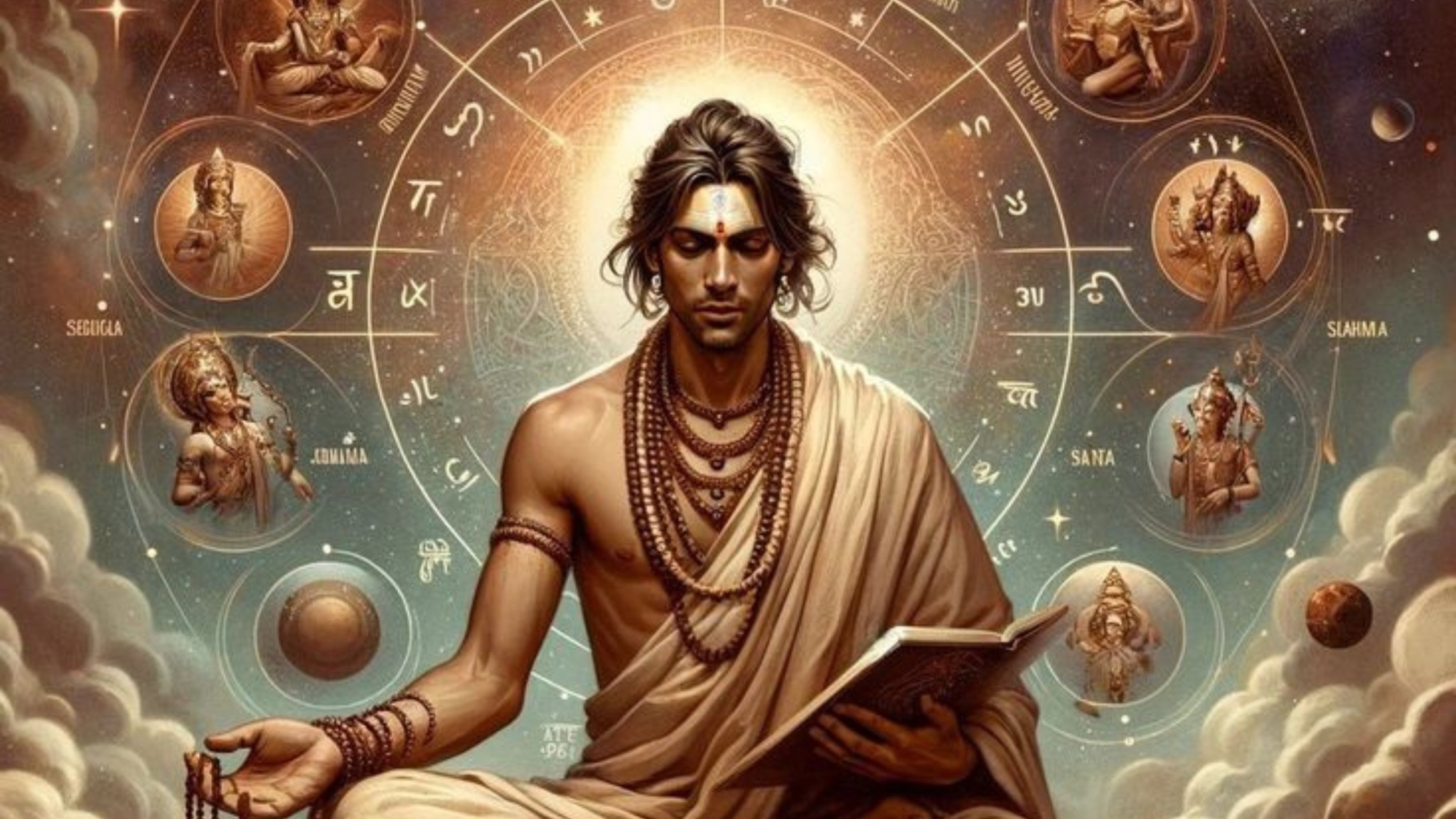
Dṛg-Dṛśya Viveka (“Discrimination of the Seer and the Seen”) is a compact Vedānta text that guides the seeker to discern the eternal “seer” (dṛg) from all that is “seen” (dṛśya). After the first ~23 verses which introduce three levels of seer and seen and the mechanism of ignorance (avidyā), Verses 24-46 deepen the enquiry: they examine how the seer is covered by the seen, how identification occurs, how knowledge dispels that cover, and culminate in the recognition of the Self as ever-free witness. Verses 24-46 thus form the vital middle to concluding section of the text, moving from theory to sādhanā and result. Click Here To Access more other text.

Benefits
Studying these verses offers significant benefits:
- Clarity on how the “I-sense” arises and how the seer becomes hidden behind what is seen — giving insight into the root of bondage.
- Recognition of the witness-Self (sākṣī) as distinct from body/mind/objects — helping to detach from identity with them.
- A method of inner enquiry: by discriminating seer vs seen one gains experiential freedom.
- Preparation for abiding as the Self — beyond roles, changes, objects, thus calmer mind, less fear and deeper peace.
- A concise roadmap: these verses provide both the fault (mis-identification) and the cure (true identification) in compact form. Click view PDF.
Verses 24-46: Bullet-point Summary
Here is a summary of each verse (24-46) in bullet-point form: translation (short), meaning, brief explanation. (The numbering may vary slightly in different editions.)
Verse 24
-
-
Translation: “When the mind, by its faculties, leans towards objects and identifies with them, the seer becomes immersed in the seen.”
-
Meaning: Identification of the Self with objects causes loss of seer-sense.
-
Explanation: The witness falls into the stream of what is seen; that is bondage.
-
Verse 25
-
-
Translation: “The functions of mind, intellect, and ego cling to the body‐mind, and so the Self assumes the nature of the instrument.”
-
Meaning: Through the body, mind, intellect, the Self seems to become the agent.
-
Explanation: Action and doership get attributed to the Self wrongly.
-

Verse 26
-
-
Translation: “When one enquires: ‘What is that seer?’ one will find that it is neither body, nor mind, nor intellect, nor any object.”
-
Meaning: The Self (seer) cannot be any of the seen.
-
Explanation: A neti-neti (not this, not that) enquiry.
-
Verse 27
-
-
Translation: “Objects, senses, mind, intellect, all are seen; the seer alone remains un-seen and ever shines.”
-
Meaning: Everything else is object; only the seer is subject.
-
Explanation: Distinguishes subject from objects.
-
Verse 28
-
-
Translation: “What cannot be objectified, that which witnesses all states of waking, dream and deep sleep without change — that alone is the Self.”
-
Meaning: Self is changeless witness of all states.
-
Explanation: Sleep analogy: when content changes, witness remains.
-
Verse 29
-
-
Translation: “Even when the seer becomes identified with the body-mind and functions in the world, he remains untouched and unaffected.”
-
Meaning: Though the Self appears to act, essentially it is unaffected.
-
Explanation: Witness nature continues even during action.
-
Verse 30
-
-
Translation: “When ignorance is removed, the one who saw himself as body-mind realises he is the witness, and then there is no more rebirth.”
-
Meaning: Removal of ignorance leads to jīvanmukti (living freedom).
-
Explanation: The goal of the text. Click view PDF.
-

Verse 31
-
-
Translation: “Meditate on the witness-Self, give up identification with body, sense-organs and mind; then all sorrow disappears.”
-
Meaning: Sādhanā instrument: meditate on the Self.
-
Explanation: Practice orientation begins.
-
Verse 32
-
-
Translation: “The sun appears to travel around the earth because of one’s limited vision; similarly the Self appears other-than one due to ignorance.”
-
Meaning: The illusion of multiplicity arises through limited vision.
-
Explanation: Analogy to correct vision.
-
Verse 33
-
-
Translation: “As the wave is nothing but water though it appears different for a time, so the individual self is essentially the Self though it appears separate for a time.”
-
Meaning: Non-duality example.
-
Explanation: The Self appears as many but is one substance.
-
Verse 34
-
-
Translation: “Even if one sees innumerable objects, the seer remains one; thus know yourself as the one witness of all.”
-
Meaning: Unity of seer despite diversity of seen.
-
Explanation: The seer is not divided.
-
Verse 35
-
-
Translation: “Different states of consciousness arise and subside, but the witness persists; therefore you are not any state, you are the witness.”
-
Meaning: Self is beyond waking/dream/sleep states.
-
Explanation: Strong pointer to real identity. Click view PDF.
-

Verse 36
-
-
Translation: “When one identifies with the instrument, one suffers; when one abides as the witness, one is free from suffering and joy.”
-
Meaning: Identification causes bondage; dis‐identification brings freedom.
-
Explanation: Practical shift from agent/enjoyer to witness.
-
Verse 37
-
-
Translation: “The witness sees the body, mind, senses and objects as mere passing shadows; he remains firm and untouched.”
-
Meaning: Witness‐view invites detachment.
-
Explanation: Perspective change.
-
Verse 38
-
-
Translation: “If one thinks ‘I am the doer/enjoyer’, he does not know the Self; when one thinks ‘I am the witness’, he knows the Self.”
-
Meaning: Shift in identification from actor to witness.
-
Explanation: Identity move.
-
Verse 39
-
-
Translation: “One who abides as the witness sees the same world but is never affected; for him nothing appears separate or other.”
-
Meaning: Oneness in multiplicity.
-
Explanation: Living non-duality.
-
Verse 40
-
-
Translation: “Just as the sun behind clouds illumines yet is hidden; so the Self illumines but is hidden by ignorance — when ignorance is removed the Self shines forth.”
-
Meaning: Ignorance is the veil; knowledge reveals.
-
Explanation: Sādhanā goal pointer. Click view PDF.
-

Verse 41
-
-
Translation: “The world is like a dream after sleep; the wise know the dreamer is the Self, and the dream dissolves.”
-
Meaning: Dream-analogy for world appearance.
-
Explanation: Helps disidentify from world.
-
Verse 42
-
-
Translation: “As soon as the sun rises, darkness vanishes; similarly when Self‐knowledge dawns, ignorance disappears.”
-
Meaning: Knowledge dispels ignorance.
-
Explanation: Simple and powerful.
-
Verse 43
-
-
Translation: “When the seer realises he is not the body, mind, senses, but the eternal witness, then his bondage ends and he attains peace.”
-
Meaning: Liberation described.
-
Explanation: Goal conqueror.
-
Verse 44
-
-
Translation: “Practise abiding as the witness constantly, and you will see the body, mind and world as transient and remain ever pure.”
-
Meaning: Continuous practice.
-
Explanation: Sustaining realisation.
-
Verse 45
-
-
Translation: “He who abides in the Self alone ever-free, needs no more scriptures; he has seen what is beyond words.”
-
Meaning: End of dependence on texts.
-
Explanation: Maturity marker. Click view PDF.
-

Verse 46
-
-
Translation: “May all seekers know the difference between seer and seen, abide as the Self in all beings, and be ever-free.”
-
Meaning: Benediction.
-
Explanation: Wish for all seekers.
-
Why Study
- Because these verses focus on the core non-dual enquiry: Who am I? and What am I not? — essential to Advaita.
- Because understanding seer vs seen is foundational to all spiritual practice — it reveals what one really is, and what one is not.
- Because when you discriminate between the witnessing Self and the body/mind/objects you begin to live in freedom rather than in reaction.
- Because this text is short, compact and potent — ideal for deep reflection and assimilation.
- Because assimilation of these verses brings a shift in identity: from actor/enjoyer to witness, which transforms how you live your life. Click view PDF.
How to Study
-
Śravaṇa (Reading/Listening): Read Verses 24-46 slowly with reliable translation and commentary (see the PDF). Note key terms: seer (dṛg), seen (dṛśya), witness (sākṣī), ignorance (avidyā), knowledge (jñāna).
-
Manana (Reflection): After each verse ask yourself:
-
Where do I identify as the seer or the seen?
-
In what moment do I feel “I am the body/mind” vs “I am the witness”?
-
How does this verse invite me to shift my self–vision?
Write down brief reflections and personal examples. Click view PDF.
-
-
Nididhyāsana (Meditative Assimilation): Sit quietly for 10-20 minutes focusing on: “I am the ever-free witness of all.” When a thought arises (“I did that”, “I feel that”), notice it as an object in awareness and return to simply witnessing. Over time the identification as the witness strengthens.

-
Repetition Schedule:
-
First reading: once thoroughly.
-
Second reading: after ~1 week — deeper reflection on the seer/seen shift.
-
Third reading: after ~1 month — reflect on how your identity is shifting in daily life.
-
Then weekly reflection for next 2-3 months; thereafter monthly review.
-
-
Group/Teacher Discussion: Discuss key verses like 26-28 (what is the seer?), 33-35 (analogy of wave/water), 40-42 (knowledge dispels ignorance). Dialogue helps clarify subtle points.
-
Daily Application:
-
When you feel upset, identify yourself as the seer witnessing the mind’s turmoil.
-
When you act, pause and ask: Is the doer really “me”? Or am I the witness observing this?
-
At end of day, reflect: How much of my day was lived as witness vs identified with the seen? Click view PDF.
-
Conclusion
Verses 24-46 of Dṛg-Dṛśya Viveka form the profound middle and culminating part of the text, offering the essential shift: from identifying with what is seen (body, mind, objects) to abiding as the seer/witness — the ever-free Self. When these teachings are deeply assimilated, the seeker lives not as “I am a doer or sufferer” but as “I am the witness in whom all is seen and yet I remain unchanged.” This enquiry is not only philosophical but transformative — it leads to a living peace, freedom from bondage, and the recognition of one’s true being.