Understanding AUM: The Gateway to the Self in Mandukya Upanishad
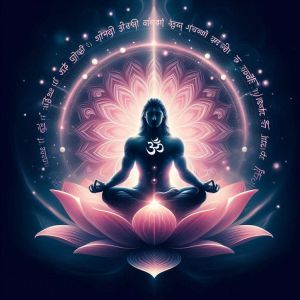
The Mandukya Upanishad is the shortest yet one of the most profound Upanishads, centering on the sacred syllable AUM as the key to understanding the nature of the Self. It explores the four states of consciousness—waking, dreaming, deep sleep, and the transcendental fourth state called Turiya. Mantras 3 to 6 explain the symbolic meaning of AUM and guide the seeker inward toward the realization of non-dual awareness. Each component sound—A, U, and M—corresponds to a distinct state, while the silence following AUM signifies the infinite, unchanging Self. This section teaches that the true Self is beyond thought, beyond experience, and is pure consciousness itself. Through meditative understanding of AUM and the direct realization of Turiya, one attains liberation and unity with the ultimate reality, Brahman. For More Information Click Here
Mandukya Upanishad – Mantras 3 to 6: The Symbolism of AUM and the Nature of the Self
Mantra 3
The syllable AUM symbolizes the entire span of consciousness in three parts.
‘A’ stands for the waking state, where awareness is turned outward to experience the world.
‘U’ represents the dream state, where the mind turns inward and imagines.
‘M’ signifies deep sleep, where one rests in undifferentiated bliss, free from desires.
Mantra 4
There is a fourth state, distinct from waking, dreaming, and deep sleep — it is called Turiya.
It is silent, beyond senses and mind, the background of all experiences.
This state is pure consciousness, without duality, without distinctions.
It is the true Self, the Atman, which is to be known and realized.
Mantra 5
Turiya is not something you can see, hear, or imagine — it is beyond all perception.
It is not inwardly or outwardly conscious, nor both — it transcends thought.
It is ungraspable, indefinable, the peaceful, blissful, and non-dual reality.
Knowing it leads to the end of suffering and the realization of Self.
Mantra 6
This Self — Turiya — is the essence of AUM, the eternal sound.
Though AUM has parts (A, U, M), the silence after them points to Turiya.
It is unchanging, beyond time and space, the basis of all states.
This is the ultimate Self, and knowing this, one becomes liberated. For More Information Click Here
Adi Shankaracharya’s Commentary on Mantras 3 to 6: Realizing the Self through AUM and Turiya
In his commentary, Adi Shankaracharya emphasizes that the syllable AUM is not merely a sound but a profound symbol representing the entire range of human consciousness. He explains that the three letters—A, U, and M—denote the waking (Vaisvanara), dream (), and deep sleep (Prajna) states respectively, which are all modifications within Maya (illusion). The fourth state, Turiya, is described as the non-dual Brahman, beyond all empirical experience, untouched by the characteristics of the previous three. Shankara insists that Turiya cannot be grasped by thought or senses, as it is not an object but the very subject—the pure witness-consciousness. The silence following AUM, he notes, symbolizes this absolute reality. Realizing Turiya is liberation (moksha), as it reveals the Self’s true nature as unchanging, eternal, and blissful Brahman, distinct from the body-mind complex. Thus, meditation on AUM becomes a means to transcend the illusion of separateness and abide in one’s true Self. For More Information Click Here
Conclusion
The Mandukya Upanishad, with Shankaracharya’s insight, reveals AUM as the gateway to understanding the Self and the ultimate truth. It teaches that the Self is not confined to the fleeting experiences of waking, dreaming, or deep sleep. Beyond these is Turiya, the silent, formless awareness that is ever-present and unchanging. By contemplating the meaning of AUM, one moves beyond illusion and duality. Shankara guides us to see that realization of Turiya is the realization of Brahman, the goal of all Vedantic inquiry. In this knowledge, the seeker finds liberation, peace, and eternal unity with the Self.
Join Our Classes:
The Upanishads are more than just ancient texts—they are timeless guides to living with clarity, balance, and inner peace. Our classes make their profound wisdom easy to understand and apply in everyday life. Join us to explore these teachings and discover a new way of seeing yourself and the world!