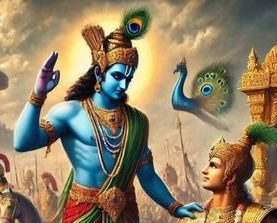
Chapter 1, Section 1: Hanuman’s Inquiry and the Path to Liberation
Chapter 1 begins with Hanuman approaching Lord Rama to inquire about the nature of liberation (moksha) and the means to attain it. Rama explains that liberation is the highest goal of human life and is achieved through knowledge of the self (Atma Jnana). He emphasizes the importance of studying the Upanishads under the guidance of a qualified Guru. The text highlights that devotion, ethical living, and meditation are essential supports for spiritual progress. Rama categorizes liberation into various types, explaining their characteristics and significance. The section sets the stage for a deeper discussion on the 108 Upanishads and the paths they prescribe for attaining self-realization. For More Information Click Here
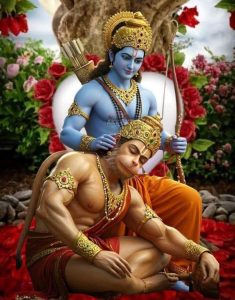
Chapter 1, Section 1 – Dialogue between Lord Rama and Hanuman on Liberation
- Hanuman asks Lord Rama about the highest goal and the means to attain liberation.
- Rama begins by describing liberation (moksha) as the supreme aim of life.
- He emphasizes that liberation is attained through self-knowledge (Atma Jnana).
- The necessity of a qualified Guru to guide the seeker is stressed.
- Rama explains that ethical living and purity of mind are prerequisites for spiritual progress.
- Meditation and detachment from worldly desires aid in realizing the self.
- Liberation is free from all worldly bonds and suffering.
- Rama mentions that knowledge of the Upanishads leads to the realization of Brahman.
- The different types of liberation are introduced briefly.
- Liberation through meditation on the supreme self is highlighted.
- The importance of devotion and surrender to the supreme is mentioned.
- Rama explains that intellectual understanding alone is insufficient without practice.
- The seeker must cultivate dispassion and discernment (viveka).
- Concentration and steady contemplation lead to self-realization.
- Liberation is beyond dualities like pleasure and pain.
- Rama introduces the concept of imperishable bliss as the nature of liberation.
- The Upanishads are described as a means to attain immortality.
- Rama enumerates that there are 108 Upanishads in total.
- These Upanishads are categorized according to the four Vedas.
- The Rig Veda contains ten principal Upanishads.
- The Shukla Yajur Veda contains nineteen Upanishads.
- The Krishna Yajur Veda has thirty-two Upanishads.
- The Sama Veda has sixteen Upanishads.
- The Atharva Veda has thirty-one Upanishads.
- Rama emphasizes the importance of learning them in order.
- Each Upanishad imparts knowledge leading to liberation.
- Some Upanishads are better suited for beginners, others for advanced seekers.
- Rama encourages Hanuman to study them with devotion.
- The Guru must explain the meaning beyond literal words.
- Direct experience of the self is the ultimate teaching of the Upanishads.
- Study combined with meditation leads to realization.
- Mere ritual or external practice without knowledge is insufficient.
- Ethical conduct supports the path of knowledge.
- Renunciation of attachment to the fruits of action is necessary.
- Rama explains that all beings have the potential for liberation.
- Liberation is accessible through sincere effort and guidance.
- The Upanishads are the supreme guide to transcendence.
- The pursuit of knowledge must be steady and disciplined.
- Rama highlights the joy of realizing the immortal self.
- Self-realization brings freedom from fear and sorrow.
- It leads to eternal bliss and peace.
- Rama assures that the seeker who follows this path attains liberation.
- Hanuman is encouraged to persist in devotion and study.
- The dialogue illustrates the blend of knowledge and devotion.
- Liberation is ultimately non-dual, beyond all distinctions.
- Rama explains that one should abandon ignorance and illusion.
- The self is eternal, pure, and identical with Brahman.
- Liberation is realization of one’s true nature beyond body and mind.
- Hanuman resolves to study the Upanishads and pursue the path shown by Rama.
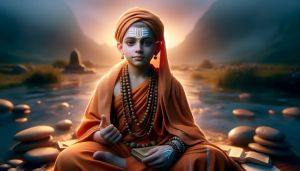
Shankaracharya’s Insights
Shankaracharya emphasizes that the ultimate goal of human life is liberation (moksha), which is realized through discriminative knowledge (viveka) between the eternal self (Atman) and the transient world. He explains that mere ritualistic practices without self-inquiry cannot lead to liberation; only knowledge combined with ethical conduct, devotion, and meditation reveals the true nature of the self. The Upanishads are the supreme scriptures for attaining this knowledge, and the guidance of a qualified Guru is indispensable for interpreting their deeper meanings. Shankaracharya also highlights the non-dual nature of reality (Advaita), asserting that liberation is the recognition of the identity of the individual self (Jiva) with Brahman, which is beyond dualities, fear, and suffering. This section, according to him, lays the foundation for a systematic study of the 108 Upanishads, guiding seekers on the path to self-realization. For More Information Click Here
Core Teaching of Chapter 1, Section 1 :
The first section emphasizes that liberation (moksha) is the supreme goal of life, attainable through self-knowledge (Atma Jnana) and direct experience of the eternal self (Brahman). A qualified Guru is essential to guide the seeker, while ethical living, detachment, meditation, and devotion support spiritual progress. The Upanishads are presented as the ultimate means for attaining immortality and transcending worldly bonds. This section also introduces the 108 Upanishads as key sources of knowledge, highlighting the importance of disciplined study and practice for realizing one’s true nature. For More Information Click Here

Conclusion
Chapter 1, Section 1 establishes that moksha is the highest aim of life and can be attained through self-knowledge, guidance of a Guru, and disciplined spiritual practice. It underscores the central role of the Upanishads as a path to liberation and introduces the seeker to the 108 Upanishads, setting the foundation for deeper study. By combining knowledge, devotion, ethical conduct, and meditation, the section provides a comprehensive framework for realizing the eternal, blissful, and non-dual nature of the self.
Join Our Classes:
The Upanishads are more than just ancient texts—they are timeless guides to living with clarity, balance, and inner peace. Our classes make their profound wisdom easy to understand and apply in everyday life. Join us to explore these teachings and discover a new way of seeing yourself and the world!