Brahmananda Valli – Anuvaka 3 , 4 & 5 with Sankara Bhasya
Anuvaka 3 defines Brahman as the source, sustainer, and absorber of all beings, urging seekers to inquire into That as the highest truth. Anuvaka 4 describes the gradual emergence of the elements from the Self—space, air, fire, water, and earth—illustrating Brahman as both material and efficient cause of creation. Sankara clarifies that this sṛṣṭi-krama is a teaching tool, not a literal transformation. In Anuvaka 5, the seeker realizes Brahman as pure bliss (ananda), the essential nature behind all existence. The joy of Brahman is uncaused and eternal—not worldly pleasure, but the Self’s intrinsic nature. Thus, the Upanishad leads from inquiry into the cosmos to the realization of one’s own Self as infinite, blissful Brahman. For More Information Click Here
Brahmananda Valli – Anuvaka 3 with Sankara Bhaṣya
Sanskrit Mantra :
“yato vā imāni bhūtāni jāyante | yena jātāni jīvanti | yatprayantyabhisaṁviśanti | tad vijijñāsasva | tad brahma ||”
Translation:
That from which all beings are born, by which they live after being born, and into which they enter upon death—know That. That is Brahman.
Sankara’s Commentary Summary:
1. The Threefold Definition of Brahman:
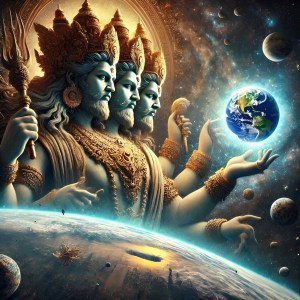
Sankara explains that this verse gives a taṭastha-lakṣaṇa (indicative definition) of Brahman based on its relation to the world:
-
Janma (Creation): “yato vā imāni bhūtāni jāyante”
Brahman is the origin of all beings. It is the efficient and material cause (abhinna-nimitta-upādāna-kāraṇa) of the universe. -
Sthiti (Sustenance): “yena jātāni jīvanti”
After creation, beings are sustained by Brahman. All life, energy, and consciousness are derived from It. -
Laya (Dissolution): “yatprayanty abhisaṁviśanti”
At the time of dissolution, all beings return into Brahman, as rivers merge into the ocean.
Sankara emphasizes that Brahman is not separate from the world, yet remains unchanging and transcendent.
2. Inquiry into Brahman:
“tad vijijñāsasva” – “Inquire into That”
Sankara notes this is a direct command to the seeker. He stresses that this inquiry (vijijñāsā) must be earnest and scripturally guided, culminating in Self-knowledge (ātma-jñāna).
He also adds:
“brahma-jijñāsā na kāryārtham, api tu mokṣārtham”
The inquiry into Brahman is not for action or worldly gain, but for liberation.

3. Identity of Brahman and Atman:
Sankara clarifies that the Brahman described here is not an external creator but the very Self (Atman) that we are instructed to realize. This bridges the seeker’s understanding from creation-based inquiry to Self-inquiry.
Key Philosophical Points from Sankara:
-
Brahman is both transcendent and immanent—it is the ground of all being.
-
This verse moves from cosmology to self-realization, guiding the seeker inward.
-
The command to “know That” implies that realization of Brahman is possible and is the central goal of human life.
-
True inquiry leads to the discovery that the Self and Brahman are one: “ayam atma brahma”.
Brahmananda Valli – Anuvaka 4 with Sankara Bhaṣya
Sanskrit Mantra:
“tasmad vā etasmād ātmana ākāśaḥ sambhūtaḥ | ākāśād vāyuḥ | vāyor agniḥ | agner āpaḥ | adbyaḥ pṛthivī |”
Translation:
From that very Self (Atman), space (akasa) arose; from space, air (vayu); from air, fire (agni); from fire, water (apaḥ); from water, earth (prthivi).
Sankara’s Commentary Summary:
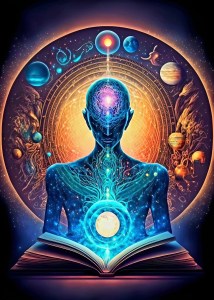
1. The Order of Creation (Srsti-krama):
Sankara interprets this verse as a progression of creation from the subtlest to the grossest:
-
Ātman → Ākāśa (Space) – the first element, representing subtle potential and sound.
-
Ākāśa → Vāyu (Air) – associated with touch.
-
Vāyu → Agni (Fire) – associated with form.
-
Agni → Āpaḥ (Water) – associated with taste.
-
Āpaḥ → Pṛthivī (Earth) – the grossest, associated with smell.
This sequence mirrors the cosmic unfolding of the elements (pañcīkaraṇa), from pure consciousness to matter.
2. Brahman as the Material and Efficient Cause:
Sankara highlights that Brahman/Atman is both the efficient (nimitta) and material (upādāna) cause of the universe. This reinforces the non-dual vision—the universe isn’t separate from Brahman but arises within and from it.
3. Srsti is Not the Ultimate Reality:
Sankara makes it clear that while the Upaniṣad describes creation, it does not imply real transformation (parimama). Instead, the process is a superimposition (vivarta)—an apparent transformation due to ignorance. Brahman itself remains unchanged and pure.
Creation is explained only as a teaching aid (adhyāropa) to guide the seeker toward the realization of the changeless Self.

4. Purpose of Explaining Creation:
Sankara says the intent is not to glorify the created universe, but to lead the seeker inward—to the source of all. The cosmic elements arise from the Self and dissolve back into the Self.
Key Philosophical Points:
-
The world is not separate from the Self—everything arises from, lives in, and merges into Atman.
-
This teaching helps to shift attention from the external to the internal.
-
True knowledge lies in knowing that you are the very source from which the universe emerges.
Brahmananda Valli – Anuvaka 5 with Sankara Bhasya
Sanskrit Mantra :
“ānando brahmeti vyajānāt | ānandād hy eva khalv imāni bhūtāni jāyante | ānandena jātāni jīvanti | ānandaṁ prayantyabhisaṁviśanti ||”
Translation:
He realized Brahman as Bliss (Ananda). For, indeed, it is from Bliss that all beings are born, by Bliss that they live, and into Bliss that they merge.
Sankara’s Commentary Summary:
1. Realization of Brahman as Ananda (Bliss):
Sankara explains that this is a positive laksana (defining mark) of Brahman—not just existence or knowledge, but Bliss itself. The seer (Bhrigu) understands Brahman as the supreme source of joy, beyond all dualities.
-
“ānando brahmeti vyajānāt” — The seer’s realization culminates in knowing that Brahman is Ānanda svarūpa—not that Brahman has bliss, but is bliss itself.
2. The Creation Sequence Revisited:
This verse mirrors Anuvaka 3, but now with Ananda as the source:
-
From Ananda, all beings are born,
-
Through Ananda, they are sustained,
-
Into Ananda, they return.
Sankara uses this to show that Brahman is not an inert principle, but the very essence of conscious joy, which underlies creation. For More Information Click Here
3. Bliss is the True Nature of the Self:
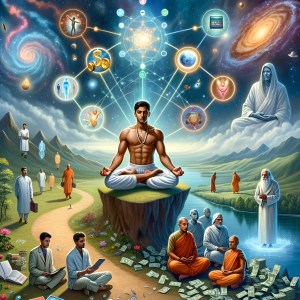
Sankara emphasizes that the highest realization is that the Self (Atman) is of the nature of bliss. This is not worldly pleasure (viṣaya-ananda), but an infinite, uncaused, ever-present joy—known through Self-realization.
4. Correction of Misunderstandings:
He warns that ordinary pleasures are reflections of Brahman’s bliss in the mind, but Brahman’s bliss is unconditioned. It is not the result of action or merit, but the very nature of the Self.
5. Culmination of the Seeker’s Journey:
This verse represents the final stage of inquiry by the seeker (Bhrigu), where he has transcended all previous layers—body, energy, mind, intellect—and now stands in direct realization of Brahman as bliss.
Key Philosophical Points:
-
Brahman is Ananda-svarūpa—the infinite, unchanging bliss.
-
The Upanishad equates bliss with the Self, reinforcing Advaita.
-
True bliss is found not in the world but in knowing one’s own Self.
-
This realization ends all seeking and sorrow—moksa is the realization of Self as Ananda.
Sankaracharya’s Vision in Anuvaka 3–5: From Cosmic Inquiry to Blissful Self-Realization
Adi Sankaracharya, in his bhasya on Anuvaka 3, 4, and 5 of the Brahmananda Valli, conveys a profound spiritual progression from cosmic understanding to inner realization.
In Anuvaka 3, he explains that the universe originates, is sustained, and dissolves into Brahman, urging the seeker to inquire into that source—which is ultimately the Self (Atman). This inquiry is not for ritualistic ends but for liberation through Self-knowledge.
In Anuvaka 4, Sankara interprets the creation of space, air, fire, water, and earth from the Self not as literal transformation but as a didactic method to illustrate that the entire universe is non-different from Brahman, which remains untouched and unchanging despite apparent creation.
In Anuvaka 5, he reveals that the true nature of Brahman is bliss (ānanda)—not experiential or finite pleasure, but the infinite, ever-present joy that is the essence of the Self. This is the final realization that brings complete fulfillment.
Together, these three anuvakas show how outer inquiry leads to inner discovery, culminating in the knowledge that the Self is Brahman—existence, consciousness, and bliss absolute. For More Information Click Here

Conclusion
In conclusion, Anuvaka 3, 4, and 5 guide the seeker from external inquiry to internal realization. Starting with Brahman as the origin and end of all, the Upanishad unfolds the process of creation to show that all elements arise from the Self. Sankara reminds us that this is a provisional explanation, meant to turn the seeker inward. The culmination in Anuvaka 5 reveals that the true nature of Brahman is bliss, not limited by time, form, or action. This bliss is none other than the nature of the Self. Realizing this leads to freedom from ignorance and the attainment of liberation.
Join Our Classes:
The Upanishads are more than just ancient texts—they are timeless guides to living with clarity, balance, and inner peace. Our classes make their profound wisdom easy to understand and apply in everyday life. Join us to explore these teachings and discover a new way of seeing yourself and the world!